Wednesday, October 28, 2009

Let's Look to Antioch

Antioch University New England, in Keene, New Hampshire, has a program that works in cooperation with schools called Community-Based School Environmental Education (hereafter, and familiarly, CO-SEED) to develop and implement place-based education projects and curriculum. CO-SEED is, more specifically, run by Antioch New England Institute (ANEI), which is a community outreach department within Antioch University.

The program speaks for itself well enough, so here is what it says:

CO-SEED, a project of ANEI's Center for Place-based Education is a three-year collaboration with particular schools and their communities to work together to develop place-based learning. By using the local natural and cultural environment as the setting for learning - and involving students in addressing community needs through hands-on service - CO-SEED projects seek to connect students, schools, curriculum, and community.

As I read more about experiences with place-based education, I have detected a recurring pattern, which you can find recorded by just about any teacher involved with this type of learning and teaching, through which such education becomes a critical and expressive venture for students as a matter of course. The process seems to go something like this: students experience a real-world phenomenon, they ask questions about it (importantly, they ask questions that use words like "what," "how," and, most powerfully, "why"), which results in seeking answers to those questions, which leads to imagining and working toward solutions, which necessarily leads to proposing visions and plans for the future.

CO-SEED is an organization with which we might consider cooperating as classroom teachers to support specific place-based learning projects as well as for acquiring ideas for implementing such projects on our own. It is important to remember that place-based education only works when students receive the support of capable, trusted, and caring adults (sometimes we call these people "teachers").

(I think this program deserves a link in the blog under "Educational and Advocacy Resources.")

Tuesday, October 27, 2009

Agriburbia

How about converting the suburbs and their lawns into self-sufficient places? How about replacing the American lawn with fields of organically grown sustainable food? Without getting too far ahead of myself I'm tempted to say, "Sign me up!"

The Denver Post reported a couple of days ago on "Agriburbia" (pic at right courtesy of The Denver Post):

[Matthew] Redmond, co-founder of the Golden-based design firm TSR Group, travels the country preaching his urban farming and development idea. He envisions a future where the nation's 31 million acres of lawn are converted to food production. He sees golf-course greens redefined with herbs; sand traps as "kale traps." He sees retirement homes engulfed by farms and office buildings where workers escape cubicles on farming breaks.

Redmond, along with his born-on- a-farm biologist turned planner wife, Jennifer, sees an urban landscape like none before.

"This is where we are all going to go. We need this," said Redmond. "Everyone thinks they are so smart by crafting a 2030 plan for the future. I say we need a $180-a-barrel plan, on how our communities can be self-sufficient when oil becomes too expensive to ship food across the country."

Self-sufficient. Sustainable. Locally produced. Agriburbia incorporates all three concepts.

In another article on the Northern Colorado Business Report website, Redmond says, "Up till now, developers just focused on shelter," he said. "We want to address the human need of food the best we can. We believe agriculture is part of the infrastructure of a development." With the price of oil going up and the total unsustainability of our current industrial food system, we can face this very practically. Consider that what we need for personal security: air, water, soil, food, shelter, and other people for community (unless you are a very rare hermitish person). At the most basic level, our living spaces ought to reflect those real needs as well as they can. Currently, they do not because they are propped up by cheap but increasingly expensive oil. Oil that has fueled the transportation and provided fuel, fertilizer, and pesticides for our industrial agricultural sector. With good planning and thoughtful use - sustainable use that thinks about security in and across our places and through time - we could have these agriburbias work. In some sense they are modernized villages from the pre-industrial centuries.

But that wasn't something they deliberately tried to do.

I called "Quint" Redmond at his office to ask him a few questions. He's a friendly and very well-spoken person apparently versed in our emerging "green" dialect. But more than that, he seems to be doing what Wendell Berry calls, "solving for pattern." In short, "A good solution is good because it is in harmony with those larger patterns – and this harmony will, I think, be found to have a nature of analogy. A bad solution acts within the larger pattern the way a disease or addiction acts within the body. A good solution acts within the larger pattern the way a healthy organ acts within the body." Agriburbia appears to be a settlement that lives within its region and its integrated in such a way that it fosters total health.

As Redmond said, "It's the intersection of real estate, development, and agriculture." All of this is being done in ways to reduce a community's footprint in food, housing, and transportation what he calls the carbon triangle because the majority of our daily communal carbon emissions come from those three areas.

He believes that the prospects for retrofitting suburbia are huge. "The inefficient use of that [suburban] land is really the problem. Suburban density is fine." But the problems emerge from poor land use and infrastructure. "It's a design thing."

If you think about a community as a huge consumer of calories - whether in food or fuel - then you might start to see suburbia much the way you look at a couch potato just sitting there doing little, consuming huge numbers of calories of potato chips, TV electricity, and home heat or air conditioning while expending few in production. But if we take that couch potato and design his living space such that he can readily dig up the potatoes himself, possibly with his neighbors, and give and share that resources in his community or region, you have changed the equation. Where a lawn sat idle, acting as a passive receptacle for water, sun, and chemical fertilizer that people groom for no instrumental purpose, you might have gardens, fields, orchards, or vineyards that sustain ecological, communal, and economic viability.

The learning possibilities are incredible. "We don't have one these projects that doesn't have an educational partner." People learn lessons about the world they live in when they are active in a community like this. The real cost of food comes to the fore. But people see that they can feed themselves, their neighbors, and people who live in densely populated cities. "The great irony is that that the industrial farmer has said that we can't feed everyone this way but you can."

After years of outsourcing our food production to others, Redmond thinks that there is the chance for some awakening in this. Maybe there will even be a reshuffling of social status. In the end, "Farmers will be right up there next to doctors and lawyers."

If you think about the industrial fractures of American life and our disconnection from those things that sustain us like air, water, and food or even our means of locomotion, a community like Agriburbia seems a step in the right direction. It evokes in urban planning what E.O. Wilson calls "biophilia" because it brings humans and nature together in a more symbiotic relatioship. "You get something that is hugely good and everyone wants to live in."
---
[Hat tip to Mike R.]

Sunday, October 25, 2009

Accountability for the PSU sustainability movement

"It is my firm conviction that the great universities of the 21st century will be judged by their ability to help solve our most urgent social problems."
—William R. Greiner, President, State University of New York, Buffalo,
Universities and Community Schools, 1994

Three weeks ago Penn State held its
Educating for Sustainability conference. I just want to follow up on that and show people a little bit about what came out of it in the form of voluntary commitments.

We decided on some "Top priorities" as follows:

1) Multi-pronged marketing (including social networking) to shift the culture, internally and outward to society.
2)
University-wide Sustainability Council to promote systemic change and culture shift.
3) Shifting curricula - throughout the disciplines and in the general education core.
4) Professional development required in sustainability for faculty and staff.

These four seemingly simple things will take some time to accomplish but we need to not drag our feet. As a group we are part of 1, 2, 3, and 4. We hope to change our culture and its values. If there is to be a council on sustainability, then as a group we need to make sure that our voice is represented and that we participate responsibly. As future teachers we have to be concerned about curricula that we are being taught and will be teaching. Finally, as professional educators, the systems of rewards made available to us and that we develop should reflect our values and good practices that emphasize sustainability.

In an article I've just read, Ira Harkavy of the University of Pennsylvania wrote:
If colleges and universities are to fulfill their potential and really contribute to a democratic devolution revolution, however, they must function very differently from the way they do now. To begin with, changes in “doing” will require colleges and universities to recognize that, as they now function, they constitute a major part of the problem, not a significant part of the solution. To become part of the solution, institutions of higher education must give full-hearted, full-minded devotion to the hard task of transforming themselves and becoming socially responsible, genuinely engaged civic universities. To do that well, they will have to change their institutional cultures and structures and develop a comprehensive, realistic strategy.
And that means, foremost, sustainability. What universities are "doing" right now through
our curriculum, operations, purchasing, development, missions, and culture is educating the future graduate to be the neediest, most consumptive, wasteful, parasitic organism that has ever lived on planet Earth. I don't say this because I believe people want to be this or that this is the only effect of a college education. But it is the most important ecological outcome that has profound economic and social effects as well. Harkavy's "genuinely engaged civic universities" should use the term "civic" to be a comprehensive environmental term such that the university helps to shape culture that addresses needs and not wants, obligations not entitlements, responsibilities and not whims.

I think it's our duty to make the quotation that opened this post true. We must judge our institutions by how well they help us solve the greatest problem humanity has ever faced - climate change. So keep your eyes peeled on these matters because we have to move the Penn State juggernaut toward more and more sustainable practices. As part of the conscience here, we have to act as it and hold it accountable.

Saturday, October 24, 2009

Shifting the power with Powershift 2009

This morning and afternoon I attended the Power Shift 2009 conference hosted at Penn State's Eco-Action. Let's just say that with some minimal preparation they got over 200 kids from around Pennsylvania colleges and universities and a small gaggle of environmental activists together for a day of hope. Hats off to the organizers!

There were four highlights for me today:

The opening speech and welcome asked us to consider what a climate bill should look like. Not what it does look like but what it should look like. The Boxer-Kerry Climate Bill (access materials on it from John Kerry's website) is starting its way through the U.S. senate and might make its way to being combined with the Waxman-Markley H.R. 2454: American Clean Energy and Security Act from the House. What's in these? What's up with cap and trade? For many people there, it is a step in the right direction because it gets us a bit closer to renewable energy. But for Greenpeace and some others, it's a bunch of the same old "Business as Usual" because it perpetuates the CO2-spewing toxic coal industry linked to cancer in children. I am not about to start taking sides in this issue right here. Suffice it to say that if we want to change how much electricity we get from dirty processes, we need to pay attention to these bills, who's drafting them, who's profiting, who's being hurt by them, and realize that if we want things to change, we need to learn a lot and do it quickly and ethically.

The "eco-model" Summer Rayne Oakes (pic at right) spoke to us as well. She talked about her voyage to becoming a spokesperson for the sustainability movement. As a girl she loved being outside and then in high school worked on stream reclamation in northeastern Pennsylvania where she saw the damage that the coal industry had done to nature there. Then, in college at Cornell, she studied sewage and bugs (she didn't tell us her major). She went into fashion modeling but carried her love of nature with her and has become a spokesperson for sustainability. I think I understood correctly when she said that she works with the Rainforest Action Network and has helped plant, run, and finance a number of tree farms in Mozambique and gotten huge high-end clothing and fashion lines like Gucci to stop making bags from wood made from the trees of the Indonesian rainforest. But she gave us a good message to get on with. Align what you believe is right in this world and must be right in this world with the work you do in your job. Work for good anywhere you can. She also shared a rather brilliant video by the Australian Youth Climate Coalition.

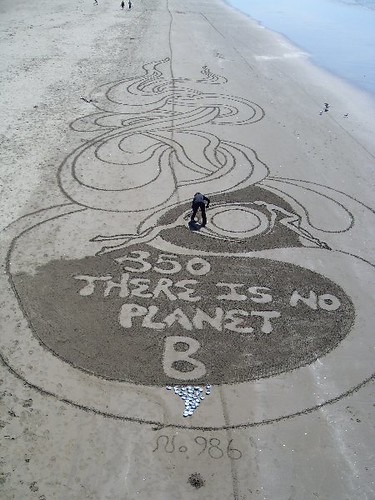
After lunch we had our photo op for the 350 International Day of Climate Action. And it was pretty awesome! We were in solidarity with roughly 5,000 other groups around the world today who are calling on our leaders to listen to us - we need to create a new world that is more sustainable and our fossil fuel use and its subsequent climate abuse must change now. From Bangledesh to South Africa, from Ghana to New Zealand, from Vienna to Sydney, from London to the Maldives, from Mongolia to University Park, Pennsylvania, we are calling for reductions across the board. It is just. It is equitable. It is good. Read about it in The New York Times too. You can see all of the photos sent in so far by going to the 350 Flicker site. It's pretty amazing stuff. [As of 8:50 on 10.24.09 Penn State's isn't up yet.] The one at right is my favorite so far. We don't have a Planet B. Let's work for this one.

At the end, I got to talk to some people who work for Penn State and with whom I have had the great fortune to begin some pieces of work to make Penn State more ecologically sustainable. One works in extension and one at Penn State Altoona. The more I involve myself at this university, the more human reasons I find to celebrate and hope. The journey to sustainability is a long one. But some of our peers and elders are wellsprings to shift the powers that be to the powers that should be.

Friday, October 23, 2009

Engineers for a Sustainable World Fundraiser.

This is kind of funny. If you're good at beer pong...or even if you're not. You can get a team together and enter a root beer pong contest.

Wednesday, October 21, 2009

Power Shift

If you are interested in getting together with a small horde of other ecologically conscious people at Penn State then this is the way to do it. Sign up for Power Shift 2009! They are helping us all network to move toward a more sustainable future..

You can read their blog on what Penn State is doing, primarily through Eco-Action, by going here. They've remarked on our "Take Back the Tap" events, the Solar Decathlon, the Vegetarian Clubs activities, and a bunch of other things too. Great stuff!

So get in on it.

Monday, October 19, 2009

Some words on James Gustave Speth's Bridge at the Edge of the World

I've just finished The Bridge at the Edge of the World: Capitalism, the Environment, and Crossing from Crisis to Sustainability by James Gustave Speth. It is a fascinating read that distills much of what must change in American life for us to achieve sustainability. Speth takes on a fast but quite detailed survey of some of the most important topics we need to consider regarding sustainability. These include the problems facing our natural and social environments because of the consumption-driven globalized American economy, how we can change that economy and what it measures, and the necessity for us to transform the economy and all of our social systems. I found the sections on environmental economics and alternatives to GDP for the measurement of affluence, abundance, and well-being to be particularly useful if general.

As an educator, I was a little bit disappointed in Speth's treatment of schools. He rightly applauds students for their activism and their calls for change. But he seems not to recognize the possibility of constructing classroom experiences that can shape our behaviors. Children and young adults spend enormous amounts of time within schooling systems and through their explicit and hidden curricula, they change who we are, what we value, and how we behave. The research may still be out there to do and the findings a ways off, but I have a strong hunch that children who attended schools with sustainability suffused through their 13 years of primary and secondary education would be more sustainable and communally-minded people than the students being put through the sorting machines made by A Nation At Risk and the No Child Left Behind Act.

All of that said, I don't really begrudge Speth this oversight; he is the dean of Forestry and Environment Studies at Yale and not a school wonk per se. Though an educator himself, he may not think seriously about the social power of schools. But I think that readers might want to consider how schools can and are building the bridge he calls us to build.

On the penultimate page, he writes the following list...almost poem:
being, not having
giving, not getting
needs, not wants
better, not richer
community, not individual
other, not self
connected, not separate
ecology, not economy
part of nature, not apart from nature
dependent, not transcendent
tomorrow, not today
This list constitutes quite a challenge for us all. I have been in the habit of lately saying that the system in which we live makes hypocrites of us all. I want so much to reduce my footprint and yet in order to get out a message about more sustainability to my technocratic friends, I have to use an electricity-intensive computer coated in plastic that uses near slave labor to acquire its parts. If I say I am my brother's keeper and say that I believe in and act upon the Golden Rule - to do unto others as I would have them do unto me - then how does my conscience allow me to use this computer? And yet, if I don't use it, will my silence allow those who exploit ignorance to become that much more entrenched and powerful? Can I use this tool to help us build that bridge at the edge of the world to a better tomorrow?

Part of what I hope for is to create not just awareness of the problems before us, but the ethical imperatives for us to act. As the above-quoted segment implies, the peril of our situation today and its accelerating dangers demand that we think not just about our own appetites today but the appetites of our children's children. Do we serve them by serving our appetites?

What does the perpetuation of something like the plastic water bottle industry mean for us and our values? On whom do we depend when we can blindly choose Fiji water over our own taps? I think that investigating that alleged "choice" shows us that we are like Dickens' ghostly children from A Christmas Carol - "Ignorance and Want" - the bastard children of an overly consumptive materialist society that isolates people from one another, from our natural wellsprings, and legally forces injustice upon us. Or we have become part of a system that Wendell Berry characterizes as "[a] symbiosis of an unlimited greed at the top and a lazy, passive, and self-indulgent consumptiveness at the bottom."

Yes, the list of problems is long and the task daunting. We are in danger and have faced ourselves with a web of systems that endanger too much life on Earth and could ruin the planet as we know it. "That is one way the world as we know it could end, down that path and into the abyss," he writes on the last page. "But there is the other path, and it leads to a bridge across the abyss." It is time to build this bridge together.

A call from the Earth Charter

Consider the following from the Earth Charter:
The Challenge Ahead

The choice is ours: form a global partnership to care for Earth and one another or risk the destruction of ourselves and the diversity of life. Fundamental changes are needed in our values, institutions, and ways of living. We must realize that when basic needs have been met, human development is primarily about being more, not having more. We have the knowledge and technology to provide for all and to reduce our impacts on the environment. The emergence of a global civil society is creating new opportunities to build a democratic and humane world. Our environmental, economic, political, social, and spiritual challenges are interconnected, and together we can forge inclusive solutions. (emphasis mine)

We are an institutionalized people. Most of us were born in an institution, formally educated in institutions, have been married in institutions, and rely on institutions for almost everything. Look at it all and you see a matrix of operations. As current students of and current and future employees of schools, we working within a decidedly value-shaping institution. This is part of our vision.

The Earth Charter recognizes this endeavor in section 14:
14. Integrate into formal education and life-long learning the knowledge, values, and skills needed for a sustainable way of life.
a. Provide all, especially children and youth, with educational opportunities that empower them to contribute actively to sustainable development.
b. Promote the contribution of the arts and humanities as well as the sciences in sustainability education.
c. Enhance the role of the mass media in raising awareness of ecological and social challenges.
d. Recognize the importance of moral and spiritual education for sustainable living.
There are contested terms here, like "sustainable development." What are we sustaining and what are we developing? Sustainability might mean just recycling (as it appears to for our friends at the International Bottled Water Association) or it might mean retracting human population to less than 2 billion people worldwide while also greatly reducing consumption as it would to someone like Revenge of Gaia author James Lovelock. But whatever your thoughts are on the term sustainability or sustainable development, business as usual cannot be sustained because our aggregate impact already overstresses our ecosystems and our communities.

So, if you find either solace or an energizing challenge in it, think about your role as a teacher hired by the creators of the Earth Charter.

What would it call you to do? What if the schools' missions were aligned with the mission of the Earth Charter instead of with the competitive rat race of the global economy?

What would they look like? What questions would you ask your students? Better yet, what questions would they ask you?

The transformation could be incredible.

What would you do? What will you do?

Sunday, October 18, 2009

The business of sustainability

I love TED Talks as you might know from previous posts. They almost always engage us with some pretty serious thinking and action in a succinct, entertaining, and often deep manner. The following is no exception.

Ray Anderson has created Interface Carpets that makes carpet conceived "cradle to cradle," meaning that his company reuses its own materials. Their mission states that "Interface will become the first name in commercial and institutional interiors worldwide through its commitment to people, process, product, place and profits. We will strive to create an organization wherein all people are accorded unconditional respect and dignity; one that allows each person to continuously learn and develop." Amazing what can follow from such a commitment and the values that manifest from them or guide them.

As TED writes it, "At his carpet company, Ray Anderson has increased sales and doubled profits while turning the traditional "take / make / waste" industrial system on its head. In a gentle, understated way, he shares a powerful vision for sustainable commerce." Brilliant. [Hat tip to Carlo and Erik.]

Watch here.