Showing posts with label Climate change. Show all posts

Wednesday, August 31, 2011

Free and open education on climate change

One of my colleagues and mentors, Don Brown of Penn State and primary author of the blog Climate Ethics, has written, "climate change must be understood as a civilization challenging ethical issue" It is the greatest technical and ethical problem human beings have ever faced.

Global? Check. Complicated? Check. Hinged on human activity? Check. Hinged on natural processes humans don't control? Check. It's possible that human-induced climate change could in the next century create an atmosphere more CO2-intense and warmer than any since the Jurassic period 150 million years ago. Sadly, there will be no dinosaurs*.

Challenges issues of justice, rights, and responsibilities? Check. Faces us with our own limits? Check. If this is the case, and climate change is a civilization challenging ethical (and technical issue) then education must respond. At colleges and universities across the world faculty have set up all kinds of courses to introduce students to the science, ethics, politics, and policies that deal with climate change. There are even signatory agreements between colleges and universities like the American College and University President's Climate Commitment, University Leaders for a Sustainable Future, Second Nature, the Copernicus Charter and others mandate that signatory institutions create greenhouse gas reduction and mitigation programs with curriculum for environmental literacy. Climate change education occupies a central part of that curriculum these days.

But all universities and colleges have limited enrollment. They have maximum student capacity made possible by people's ability to gain admission and their ability and willingness to pay. How can someone something like course in climate change without going to college?

The Pacific Institute for Climate Solutions now offers online courses that take the lay person through the science of climate change. They have an Introduction, a lesson on CO2 and the greenhouse effect, Mother Nature's influence on climate, observable changes in climate, and finally climate modeling. What's great to see as teachers is that there are learning outcomes for each of them that build upon the previous lesson and enabling further understanding, connected to other resources through the home website, and also linked to education for sustainability in British Columbia and abroad (pdf here).

It might be the case that understanding the what and the how of climate change are very important. But at some level answering the question "Why have humans used technologies that caused climate change to begin with?" might be more important. If we can answer that question, we might be able to figure out how we can change society to mitigate our impacts on the climate and thus ourselves. But that might be a really radical form of education and possibly the kind of education that ethically grounds a better civilization.

---
* There has been woolly mammoth DNA found and some people would like to engineer and birth a mammoth. Jurassic Park may be less fictional than we thought.

Thursday, September 23, 2010

Bill McKibben coming to Penn State on October 4th

Noted environmentalist and author Bill McKibben to speak on October 4, 2010

Bill McKibben will speak on the University Park Campus on Monday October 4, 2010 as part of the annual Colloquium on the Environment Speaker Series. His lecture, “The Most Important Number in the World,” is scheduled for 6:00 p.m. in the Auditorium of the HUB-Robeson Center. A book signing will immediately follow his lecture. The event is free and open to the public.

Bill McKibben is an American environmentalist and writer who frequently writes about global warming and alternative energy and advocates for more localized economies. In 2010, the Boston Globe called him “probably the nation’s leading environmentalist” and Time magazine described him as “the world’s best green journalist." In 2009 he led the organization of 350.org, which coordinated what Foreign Policy magazine called “the largest ever global coordinated rally of any kind,” with 5,200 simultaneous demonstrations in 181 countries. The magazine named him to its inaugural list of the 100 most important global thinkers, and MSN named him one of the dozen most influential men of 2009.

“Penn State continues on its path to achieve a 17.5 percent reduction in greenhouse gas emissions by 2012 and is currently working on the next plan. We are looking forward to Bill McKibben’s presentation and hope to be inspired to do even more,” explained Steve Maruszewski, Assistant Vice President of Physical Plant and Manager of the Finance & Business Environmental Key Initiative.

McKibben is the author of numerous books. His first book, The End of Nature, was published in 1989 is regarded as the first book for a general audience about climate change. In March 2007, McKibben published Deep Economy: the Wealth of Communities and the Durable Future. It addresses what the author sees as shortcomings of the growth economy and envisions a transition to more local-scale enterprise. In April of 2010, he published Eaarth. In Eaarth, he insists, we need to acknowledge that we’ve waited too long, and that massive change is not only unavoidable but already under way. Our old familiar globe is suddenly melting, drying, acidifying, flooding, and burning in ways that no human has ever seen. We’ve created, in very short order, a new planet, still recognizable but fundamentally different. We may as well call it Eaarth.

He is a scholar in residence at Middlebury College and lives in Vermont with his wife and daughter.

The annual colloquium is sponsored by Penn State Institutes of Energy and the Environment and the Finance and Business Environmental Stewardship Strategy at Penn State. This year’s event is also sponsored by the Center for Sustainability and Penn State Outreach. The event has brought numerous high-profile guests to campus including Robert F. Kennedy Jr., Christine Todd Whitman, William McDonough, Amory Lovins, and David Suzuki.

Contact for more information:

Patricia Craig
plc103@psu.edu
814.863-0037

Paul Ruskin
pdr2@psu.edu
814.863.9620


Milea A. Perry
Program Coordinator
Penn State University
Campus Sustainability Office

1 Land and Water Building
University Park, PA 16802
Email: map40@psu.edu
Phone: 814-865-2714


websites:
www.opp.psu.edu
www.green.psu.edu

Wednesday, August 25, 2010

"The wisdom to follow nature’s example..."

These were my statements to the press today for the National Wildlife Federation's call for more sustainable action:

Thank you for coming today.

It is my great joy to say that the Centre region gifts us with abundant rainfall, mountain gap streams, deep wells, fertile soil for agriculture, gorgeous forests, and wildlife that brings rich experiences to all lives. As a modest gardener and naturalist (and I do mean modest), mountain biker, teacher, and father I love this place so much.

By disposition, I am an optimistic person. What isn’t to love about the Seven Mountains or the fields of the Penns Valley? Just go to Allen Seeger or Penn’s Creek and you will know what I mean.

But by forecasts and data, I am a pessimist. I doubt our collective ability to get out of this mess. As a nation, we are failing to act responsibly in the brotherhood and sisterhood of nations. As a wealthy community, much of whose wealth comes from the dizzying success of Penn State University, we are failing to act responsibly in the brotherhood and sisterhood of interconnected Pennsylvania communities. Why?

If you look at the data of the recent past and the experience of too many people in Pennsylvania and the American northeast you find troubling trends.
- Pennsylvania, according to an assessment released last year by Pennsylvania Department of Environmental Protection and the Governor’s office, generates 1% of the world’s greenhouse gas emissions though we only house a smaller portion of that global population.
- We see fish kills in rivers because of rising temperatures that make life great for fish parasites and awful for fish. Fishermen can tell you this. This is climate change in action.
- If you listen to farmers, like my Uncle Tony from Whitney Point, New York you know that hay crops come in almost a month earlier than they did in the 60s. And it’s not because of advances in fertilizers. Steadily rising seasonal temperatures.
- If you listen to the Union of Concerned Scientists you’ll see that temperature spikes caused by climate change hurt everything from the hemlock tree susceptible to bark beetles to dairy cows who have trouble thermoregulating in extreme heat let alone produce milk under duress. Many of us eat beef and drink milk. This will be a challenge.
- If you examine the wake of our fuel consumption, you see tragedy. Whether it’s the TVA coal ash spill almost two years ago, the Gulf oil gash and geyser, or the natural gas tragedies across the Marcellus Shale in Pennsylvania and the delinquent companies that run them, we are confronted with the limits of our progress at the expense of people and the places where they live with the plants and animals that support them

All of these things align with the sad and quite certain statement contained in the National Wildlife Federation’s 2010 report.

Let us speak plainly. Poor and weak people and the non-human environment have paid, are paying, and will increasingly pay for our way of life. These may seem like radical statements but they are corroborated by too much data to be waved away.

If we want to live with something approximating the standards of living we enjoy, we need to act now to maximize our collective welfare in a way that stops doing what President Lyndon Johnson called an experiment with the atmosphere. This is no longer an experiment. Today, the United States plays a game of chicken with other “developing nations” that is running millions of humans off the road, runs over thousands of non-human species a year, and is in a collision course with the physical limits of our planet. The United States, for all its power and might, cannot overcome planetary physics. Nature limits us.

We rely on fossil fuels the way that dope fiends rely on heroin. We all do. In this room almost every piece of technology that we use relies on coal, natural gas, or petroleum. They will run out. Everyone knows this. You. Me. Ed. Dr. Mann. We all know. And yet we do not collectively act to change it knowing that we are driving ourselves right over an abyss. It’s like we are the alcoholics on the Titanic who’d rather fight for the last bottle of bourbon when we know that we can survive if we just drop it and get on the lifeboat…if we only knew where the lifeboat is.

I think we do know where it is. It is in a more sustainable way of life. To start, and only to start, it lives in the reduction of our dependence on the obviously disastrous path before us that will bring us to 600 ppm CO2. In part, that means a retooling of our national economy, our industry, and our education systems away from fossil fuels and focus them on the sources that have fueled organisms on this planet for billions of years – plants have harnessed the sun and birds and insects have taken flight on the wind and we all need water. With all of our ingenuity and intelligence, I hope that we can have the wisdom to follow nature’s example and sustain ourselves without eating ourselves, and the rest of nature, in the process.

Thank you. (Peter Buckland)

Tuesday, August 24, 2010

The National Wildlife Federation's "Extreme Heat in Summer 2010"

This in from the National Wildlife Federation:

The National Wildlife Federation has released “Extreme Heat in Summer 2010.” This summer is the hottest on record so far and a sign of more to come. The Eastern and Southern United States are especially suffering, with many states having one of their hottest summer months on record. A new analysis from National Wildlife Federation finds that summers like the current one could become the norm by 2050 unless steps are taken to curb global warming. Philadelphia and Pittsburgh are on a list of those cities most vulnerable to heat wave effects as the planet warms. Approximately half of the residents in both cities have relatively high levels of vulnerable populations and low rates of air conditioning.

The analysis comes a few weeks after the U.S. Senate shelved action on comprehensive climate and energy legislation.

The State College community is better equipped than most to deal with extreme heat because most residents have air conditioning. However, many communities are not so fortunate. Our failure to take action on global warming will affect those who can least afford to deal with extreme temperatures. It is the poor, elderly, and those with health problems who will bear the brunt of the expected extreme heat events.

When: August 25, 2010, 10:30am

Where: Schlow Memorial Library, Community Room

Who: Dr. Michael Mann, Director, Earth System Science Center, Penn State University
Prof. Sylvia Neely, Creation Care Coalition, Pennsylvania Interfaith Power and Light.
Arno Vosk, MD, Fellow of the American College of Emergency Physicians
Peter Buckland, President of Environment - Ecology - Education, Penn State University

Contacts: Ed Perry, National Wildlife Federation, Phone - 814-880-9593
paglobalwarmingoutreach@gmail.com

Tuesday, March 30, 2010

Climate change education workshop

Orion Magazine and Unity College in Maine are teaming up to teach us how to teach climate change. The following release explains it all:

Education in a Changing Climate Workshop
August 1 - 4, 2010

Climate change is not just for scientists to deal with. It’s a challenge for us all, and we need everybody’s skills and perspectives to confront it—now. But the scope and complexity of the issue can seem intimidating and frustrating, like trying to grasp hot air. How can we understand global and long-term problems when we live and work in the here and now? Do we need to be experts before we even mention climate change in public or add it to our teaching?

Join us at Unity College for a 4-day workshop that will give you powerful, practical ways to move past anxiety and educate yourself, your students, and the public.

We’ll offer a climate change primer on basic climate science, likely effects on ecosystems and people, some ethical, literary, and artistic responses, and a sampling of potential solutions that range from political to personal, technological to philosophical. In each case, we’ll show you where to find the best current information and teaching resources.

Through hands-on activities, we’ll explore how to combine place-based teaching with this global problem. We’ll explore outdoors with a Unity College naturalist, write, make art, and consider how to deal with the perspective-bending nature of climate change. In short, we’ll exercise our brains and imaginations in the service of practice.

Education in a Changing Climate is an annual event jointly sponsored by the Orion Magazine and Unity College. Orion is a bimonthly, advertising-free magazine that stakes out the territory of ecology, the arts, action, education, and social justice. Unity College is a learning environment where sustainability and environmental awareness are central to the school’s mission and vision and is intrinsic to all aspects of college life—ranging from the curricular focus on the environmental liberal arts, to the campus-wide emphasis on energy efficiency and local foods.


Friday, February 26, 2010

Sustainability Now: "Climategate" Friday February 26th

I am co-hosting Sustainability Now radio on the Lion 90.7 fm with Mike Shamalla (Graduate - Landscape Architecture). We air on Fridays from 4-5 pm. Last week we had three student activists including our own Jared Blumer.

Today, we will be talking to Ed Perry, the Global Warming Campaign Outreach Coordinator for the National Wildlife Federation. We'll be talking about the "Climategate" dust-up, something I obviously have some pretty strong ideas about. Read the show preview here.

You can follow our progress on our blog linked above. Tune in Fridays 4-5 pm to 90.7 or stream it online.

Saturday, February 13, 2010

The NEWS on this rally

Well I guess we have some news coverage on this too. Watch the local NBC clip (yours truly and all). As I say in the clip, "I love me some ignorance." But I have mixed feelings about this actually knowing that I am fully a press hound.

On the one hand, I am glad that our voice and my voice gets to get into the media. If it's just this denialistic caricature of science, the peer review process in natural sciences, and checks and balances by vested interests, we might as well just get whatever sort of YAF realism ideology in order to review the work of scientists.

On the other hand, I think it's ridiculous that the press doesn't just look at the available scientific literature and say, "Wow! What a bunch of fringe whackaloonery we are attending to." Sigh. So it goes.

Friday, February 12, 2010

Transparency and transparent ignorance

That "Climategate"protest held by the Young Americans for Freedom (YAF) and the 9.12 Project was about at least two things: transparency and ignorance. On the one hand, they called for transparency from Penn State in Michael Mann's case surrounding these leaked emails from East Anglia University Climate Research Unit hoping for an independent investigation. On the other hand, it was also an appalling display of ignorance by people invested, for whatever reason, in denying climate change. We'll tackle these two things as we move through a loose narration and description of the event.

Just before the protest started, I met up with several members of Penn State's Eco-Action and a couple of the College Democrats to get IPCC handouts in order and a couple of signs. A young woman was also there gearing up a camera with which to interview YAF and 9.12 members to sort of see why they were there and what not. I take it that video will be coming out soonish. We'll be posted I'm sure.

Outside of the HUB the protesters geared up a little banner decrying "Mann's Nature trick...to hide the decline." That's a reference to one of the stolen emails from the East Anglia database regarding some research methods. As RealClimate.org reports it (one of whose contributors is Mann himself):
“Declines” in the MXD record. This decline was hidden written up in Nature in 1998 where the authors suggested not using the post 1960 data. Their actual programs (in IDL script), unsurprisingly warn against using post 1960 data. Added: Note that the ‘hide the decline’ comment was made in 1999 – 10 years ago, and has no connection whatsoever to more recent instrumental records.
So this alleged "hidden" decline was reported in the scientific literature itself, the method was written up and included in peer-review, and happened more than 10 years ago, during which time climate science has only found more empirical data to support human-induced climate change.

One of YAF's members stood on a milk crate and gave a speech. He decried Penn State's investigation on this matter (here in pdf). They have not been thorough enough. They are playing semantic games with the word "trick" that remind him of Clinton's squabbles over the definition of "is." Look, the context matters. What one guy calls a "trick" in an informal email that relates to something vetted through years of scientific work is not like a magic trick used for deception by Penn & Teller or the Houdini. Once again on this matter I defer to the editor of Nature on this matter:
One e-mail talked of displaying the data using a 'trick' — slang for a clever (and legitimate) technique, but a word that denialists have used to accuse the researchers of fabricating their results. It is Nature's policy to investigate such matters if there are substantive reasons for concern, but nothing we have seen so far in the e-mails qualifies.
Not many organizations out there will have that much more interest in protecting science's integrity than Nature. And Penn State, whose reputation has come to be built on a very strong research and development program, is not so interested in crashing itself to save one guy. Who conducted the last investigation?

The Collegian reports that "[t]hree Penn State employees, Henry C. "Hank" Foley, vice president for research and dean of the graduate school; William Brune, head of the meteorology department; and Candice Yekel, director of the Office of Research Protections, sat on the inquiry panel." One of the original possible panel members, Dean of Earth and Mineral Sciences William Easterling, recused himself because of conflicts of interest. Office of Research Protections must protect the research integrity of the university. They are the biggest pain for researchers because they oversee so much and examine the ethical ramifications of what people do and they have to be responsive to government agencies like the National Institutes for Health and the like. I'd think that Candice Yekel (who I also know personally) isn't about to jeopardize her position for Michael Mann.

The good of the one does not outweigh the good of the many and it is not in the investigating panel's interest to clear Mann of charges of which he is guilty. As our own Collegian reported, "the panel concluded there is "no substance" to the first three allegations: falsifying or suppressing data, intending to delete or conceal information and misusing privileged or confidential information." They reached this conclusion after doing the following (see report pdf link above):
• 206 emails that contained a message/text from Dr. Mann somewhere in the chain;
• 92 emails that were received by Dr. Mann, but in which he did not write/participate in the discussion; and
• 79 that dealt with Dr. Mann, his work or publications; he neither authored nor was he copied on any of these.

From among these 377 emails, the inquiry committee focused on 47 emails that were deemed relevant.
Now this made the YAF speaker nuts. He had this 10-page mind-numbing (he used some term like that) document from Penn State on the Mann investigation. "47 emails! Just 47 emails out of more than 1,000 emails." He then made fun of this process and the university for focusing on "47 emails!" This is what we call selective quoting or "quote mining." Tell people that more than 1,000 emails were taken in and then make it about 47 emails without noting at all how the panel decided to get to it. So the context of the process of the panel is annihilated and misrepresented for political points. Isn't there something almost beautifully hypocritical and paradoxical about a group who is out for the truth about documentation, transparency, and process misrepresenting documentation, transparency, and process? I think so. What about the fourth allegation?

The committee have punted on the fourth accusations so that it can be taken up by good people who are qualified to assess it. They write:
Given that information emerged in the form of the emails purloined from CRU in November 2009, which have raised questions in the public’s mind about Dr. Mann’s conduct of his research activity, given that this may be undermining confidence in his findings as a scientist, and given that it may be undermining public trust in science in general and climate science specifically, the inquiry committee believes an investigatory committee of faculty peers from diverse fields should be constituted under RA-10 to further consider this allegation.

In sum, the overriding sentiment of this committee, which is composed of University administrators, is that allegation #4 revolves around the question of accepted faculty conduct surrounding scientific discourse and thus merits a review by a committee of faculty scientists. Only with such a review will the academic community and other interested parties likely feel that Penn State has discharged it responsibility on this matter.
So they appointed five investigators unattached to this climate business. The Collegian reports:
Five Penn State faculty members will sit on the investigation committee into the fourth allegation: Mary Jane Irwin, a computer science and electrical engineering professor; Alan Walker, an anthropology and biology professor; Albert Welford Castleman, a chemistry and physics professor; Nina Jablonski, an anthropology professor; and Sarah Assmann, a biology professor.

[Candice] Yekel [of the Office of Research Protections] will provide administrative assistance to the committee, according to the report. The investigation will take 120 days from initiation to completion, university spokeswoman Lisa Powers said.
So now you have five high-powered nationally and internationally respected scientists determining whether Mann's actions undermined "public trust in science." Seems to me that we have very good people working on this. But it's not enough for YAF and the 9.12 guys. They want to "Turn up the HEAT on Mann!" They want independent investigators. According to one of the protesters, the National Science Foundation is available for this investigation. Once again, I find it odd that an essentially anti-government group wants a government organization that works with funding on this issue to investigate Mann.

This group says they want "transparency." Me too. You should too. Science should be quite transparent within the limits that organization's put on the availability of their data. Sadly, the public cannot always see behind the process because nations, states, corporations, and other institutions simply make things confidential. As a sidenote, I don't see Pfizer or Exxon Mobil making their R&D transparent.

But this is beyond transparency. It's hounding of a very old kind that Chris Mooney documents quite well in The Republican War on Science. Pro-economic growth big business interests aligned with libertarians aligned with anti-science religious conservatives just can't take climate change so they call for "transparency" to serve their obstructionist tactics. That's Orwellian.

I, personally, do not find any of this to warrant much more investigation. In general, this is just more denialism being legitimated by the media. I don't object to the NSF doing an investigation in principle, but it seems a waste of time and more ways for climate denialists to keep their incredible celebration of ignorance in the media spotlight.

And what a celebration of ignorance it was. There was a guy holding up an American flag and saying things like, "Global warming? Haven't you noticed how cold it is?" Another guy said, "I want all those people to go stand in the ice and snow over there and tell me about global warming" or something very close to that. [Sadly, I didn't have my recorder out for this so my quoting is slightly off.] Both of these guys show that they fundamentally do not understand climate change, that they are deluded on the subject, or want to just lie about it. I point you all to the National Science Foundation's materials on it; you know, that group these denialists want to investigate Mann. The NSF calls climate change "the most important puzzle that humankind has attempted to solve."

The Nobel-Prize-winning Intergovernmental Panel on Climate Change’s (IPCC) Climate Change 2007: Synthesis Report from its Fourth Annual Report warns us that the problem’s severity is escalating and accelerating:
Warming of the climate system is unequivocal, as is now evident from observations of increases in global average air and ocean temperatures, widespread melting of snow and ice and rising global average sea level” and that “observational evidence from all continents and most oceans shows that many natural systems are being affected by regional climate changes, particularly temperature increases.
Grounds for “skepticism” have been soundly refuted. According to Naomi Oreskes' literature review on the subject, of 928 papers on climate science published between 1993 and 2003, there was no significant dissent from “the consensus view…[that] climate change is caused by human activity” leading to the conclusion that the evidence for human-induced climate change is “clear and unambiguous." In the five years since her paper was published, that consensus strengthened.

It's pretty stunning to watch this kind of entrenched anti-reason at work. In our work as teachers of ecological literacy, I hope to do better for a better tomorrow.

---

In a closing note: There were multiple media outlets there. I was interviewed by a Collegian reporter and someone from one cable news channel. The YAF and 9.12 Project folks and people from some environmental groups including Eco-Action were interviewed as well. Watch local stations and check the paper next week.

Thursday, February 11, 2010

Counter the YAFhoos

This just in from Eco-Action:
EcoAction is going to work to defend Dr. Michael Mann and the entire Intergovernmental Panel on Climate Change tomorrow out front of the HUB. We will be meeting outside of our office in the HUB at 11:30 AM tomorrow (Friday) in order to distribute fact-filled hand bills to people who want to help pass them out outside of the HUB. Please come and help speak out in the name of science.
Come on out!

So what do you say to this denialists?

As I posted in the last piece, there is a cavalcade of climate conspiracy theorists out there. "Climate change is a hoax!" they cry.

So I just wonder what they think of this story from Penn State Live: 'Supra-glacial lakes' are the focus of a new Penn State study. They write the following:
University Park, Pa. -- Rising temperatures on the Greenland ice sheet cause the creation of large surface lakes called supra-glacial lakes. Now a Penn State geographer will investigate why these lakes form and their implications...

"Learning where lakes are, how they form, and how that changes through the melt season can help us really understand a lot about important processes that control how the Greenland ice sheet responds to warming," Lampkin said.

Supra-glacial lakes form when melting water collects in pools in the lower levels of the ice sheet in melt or ablation zones. These lakes drain rapidly through cracks in the ice channeling water to beneath the ice sheet, affecting how ice sheets move and how pieces calve off into the ocean.
I wonder what tomorrow's Young Americans for Freedom and 9/12 Project protesters about so-called "Climategate" think of this direct empirical evidence positively correlated with rising human-produced atmospheric greenhouse gases. Is this a joke to them? To my mind, that is willful ignorance. When will there be enough evidence for them?

Yahoos are going to protest "Climategate"

Warning: This post is a piece of political activism written on the author's behalf and do not necessarily represent the views of all the 3E-COE's members.

In case you haven't heard, climate change denialists in the United States are all atwitter over thousands of emails stolen from East Anglia University's climate program. One of their prime targets has been Michael Mann at Penn State University who some have alleged has fabricated conclusions by using a "trick" commonly used in sciences that use statistics. They call it Climategate!

Do they even understand what the science is? I can't tell. They should get into the peer review process of science journals and learn how climate science is actually done by climate scientists.

The editor of Nature, one of the world's two most prestigious and rigorous scientific journals (Science is the other) wrote the following:

Nothing in the e-mails undermines the scientific case that global warming is real — or that human activities are almost certainly the cause. That case is supported by multiple, robust lines of evidence, including several that are completely independent of the climate reconstructions debated in the e-mails.

First, Earth's cryosphere is changing as one would expect in a warming climate. These changes include glacier retreat, thinning and areal reduction of Arctic sea ice, reductions in permafrost and accelerated loss of mass from the Greenland and Antarctic ice sheets. Second, the global sea level is rising. The rise is caused in part by water pouring in from melting glaciers and ice sheets, but also by thermal expansion as the oceans warm. Third, decades of biological data on blooming dates and the like suggest that spring is arriving earlier each year.

Denialists are against this stuff because it is the clearest evidence out there that the following equation is true:
Fossil-fuel intensive industrial technological activity x Growth economy = Ecocide
The plain truth of this equation is too obvious to ignore as Nature's editor pointed out above. Michael Mann's statistical trick may be a way to play with data; that's what research can be: playing with data to see what's in it. But people want Mann's head on a platter.

Here at Penn State, a group of notable denialists, The Young Americans for Freedom, are going to protest. Good. I am eager to see this public display of intense ignorance and brow-beating. Here's what their press release says for the Climate Gate protest:


Do you care about academic integrity? Today, a group of three Penn State employees are supposed to conclude an inquiry into whether PSU professor Michael Mann violated university policy. If these three employees so choose, they can clear Mann of wrongdoing, and cut off any further investigation.

A PSU professor is involved in an international, climate-related scandal, and the internal inquiry involves only three people, all of whom are Penn State employees. No outsiders will monitor the proceedings. Does this seem right to you?

If the initial inquiry decides that Mann needs to be investigated further, a committee of five tenured Penn State professors will be appointed to do the job. Again, there will be no external oversight. Does this seem right to you?

Even if the Penn State investigation committee finds that Mann did wrong, they are under n! o obligation to inform the public—the only people they are required to inform are Mann’s donors. Again, does this seem right to you?

Penn State is the ninth ranked university in the country for receiving government research and development grants. Don’t you think they should be held to a high standard?

Come join us when we take a stand for honesty, integrity and truth on February 12th, at noon, in front of the Hetzel Union Building on Penn State’s University Park Campus (Pollock Road entrance). Your commitment and concern will make a difference! This demonstration is jointly sponsored by PSU Young Americans for Freedom and The 9-12 Project of Central PA.
High standard? Do they know anything about the people investigating him or for what the final charge is? I have met two of them: Nina Jablonski is an anthropology professor and head of Department of Anthropology at Penn State. She was on the Colbert Report too for her book Skin. and Alan Walker. Walker is a fellow in the National Academy of Sciences. He's one of the most vetted and admired anthropologists in the world writing on human evolution. You think they want science to suffer as a discipline? I think not. What external oversight committee do these people want? Exxon Mobil's front groups? The FBI? Lehman Brothers and all their "free market" friends?

I think I will try to make it. So will some of the folks from Eco-Action. If you go, bring some counter-signage and be prepared for a bit of spectacle. If you feel so compelled, please write letters to the editor of The Collegian decrying this as nothing short of denialist tragedy.

Friday, January 29, 2010

Moral and Ethical Dimensions of Climate Change

As reported here a few days ago, three Penn State professors gave a talk about the few successes and many failures that emerged from COP 15. Dr. Don Brown, Dr. Nancy Tuana, and Dr. Petra Tschakert went as observers for Penn State. They provided a rundown of the ethical issues involved, generally referring to it as “climate justice,” “climate ethics,” or “the moral and ethical dimensions of climate change.”

386.7 parts per million: the Earth’s current atmospheric concentration of CO2. Based various data sources, that CO2 concentration is ~100 ppm higher than pre-industrial levels of ~280 ppm. Combined with other greenhouse gases (GHG) such as methane, water vapor, and refrigerants, CO2 causes climate change by warming the atmosphere on average. These effects disrupt longstanding climatic forces which in turn disrupt ecosystems – from rainforests to high tundra – which disrupt non-human and human communities which in turn harm an uncountable number of organisms. Climate scientists practically universally agree that industrial humanity has caused this problem and must act responsibly for the biosphere’s welfare, primarily for human welfare (watch this video made by the Rock Ethics Institute).

Politically and economically powerful people must positively answer the moral and ethical call to understand the many problems that we have caused and must work to curb damages, support the poor people who are and will be affected, must develop mitigation and adaptation behavioral and technological strategies, and must conserve much of the natural world. Many hoped that some meaningful action in this direction could come from COP 15, the 19th international climate summit held in Copenhagen, Denmark at the end of last year.

Issues include: How much money has been put in and should be put into adaptation funding and who should control that money? How should we deal with climate exiles such as people who will be displaced by rising sea levels such as people who live in the Maldives, Florida, Louisiana, India, and Bangledesh? How do notions of human rights play into this? What land should be set aside and who should control that land? How much risk should we put on future people? Are we worth more than them? What should their quality of life be?

Most contentiously in the United States, who should be responsible and who should pay? I note that the final question is most contentious in the U.S. because the U.S. is responsible for the emission of 27% of GHGs through history and by most standards of justice, the U.S. would pay for the humanitarian and ecological costs others are forced to take because of our economic "progress." Not that some of those costs are unquantified by current economics and maybe should remain that way. These would call for qualitative changes in life as well such as dietary and consumer habit shifts.

All of those "shoulds" or "oughts" show that these are moral and ethical questions. What is right and wrong and what beliefs and actions ought to follow?

Don Brown, Nancy Tuana, and Petra Tschakert all agreed at the end of the panel on a few things. First, we are responsible and should be acting in ways that are more sustainable. In daily life, we can consume less by just walking or cycling more and driving less. To extend this rather obvious idea, the simple act of slight reduction in the United States can have the effect of drastic change in a "less-developed" country. About 20% of our carbon footprint comes from diet much of which comes from food transportation, effectively equaling the footprint of an entire Pakistani family or Cameroon village. Efficient local food eating can greatly reduce that portion of our footprint as can simply eating less meat.

Second, we should "turn up the volume on the moral and ethical dimensions of climate change." Powerful people will not change policies and practices without pressure. That pressure can be through letters to politicians, phone calls, visits to offices, discussion with our friends and family, changes in buying habits, or activism which could well include civil disobedience. But if this is a justice issue that calls us to be responsible and responsive to the rights of others then we must act responsibly and loudly and clearly call on others. Pump up the volume.

Third, we must educate well. It is my (and I suspect the three panelists') firm belief that as teachers in the Deweyan sense that we need to guide students toward their understanding of their own moral duties and responsibilities by teaching morality instead of teaching about morality. What we do and how we do it in our formal schooling matters. The creation of more sustainable schools will shape behavior and moral sense. This is our place to be what we believe as ecologically-minded educators.

Our road is in front of us and this semester we will be going this way. We will join one another to consider Wendell Berry's work from "solving for pattern" (.pdf) and consider how to use the Center for Ecoliteracy's curricular companion for Food, Inc. We will keep pressing the water bottle issue and open people's minds to greater good through less use and waste in the place where we live.

Join us every first and third Thursday this semester in 134 Cedar Building at 7:30 pm. Be the good we need in this world. Help us raise the volume.

Tuesday, January 19, 2010

Mark your calendars! Panel discussion on Climate Change and Justice


We have the amazing good fortune to have people who can talk substantively about the climate change talks and (in)justice issues that climate change brings to the forefront. I really encourage everyone to go to this talk.

Last fall I served on a panel with Dr. Tuana about sustainability and the need for interdisciplinary work at the Educating for Sustainability Conference. Dr. Brown was the moderator. It was a pretty interesting panel that reinforced my strong conviction that we need to integrate traditional disciplines, examine our assumptions about what we do as citizens and professionals, and evaluate our collected work with conviviality and the common ecological good in heart and mind. Additionally, I have had the good fortune of working with Don Brown (a regular contributor to Climate Ethics) as an assistant for the Pennsylvania Environmental Resource Consortium. Dr. Brown is the current chair. Erik Foley is our new sustainability coordinator at Penn State. I've had several meetings with him and he has quite a job to do - "greening" our university so to speak. I have not yet met Dr. Tschakert.

Check it out.

Thursday, December 10, 2009

What youth do better than anybody

Refuse. Resist. Disrupt. Disturb.

The energy behind the climate change awareness and action movement right now is kind of electrifying. Reports, blogs, and videos are pouring out of COP15 showing that youth have marked climate change as the issue of our generation and, it seems, for generations to come. It is grounding us and elevating our ideals and goals to bring about a revolution that centralizes global human economic, social, and cultural welfare and maximizes non-human life's welfare. We are coming to see a groundswell of systems thinking, ethical awakening, and meaningful action.

And some of that action is to simply disrupt nonsense like that held by so-called climate "skeptics." What that term really means is climate change denialists, people whose entrenchment in the status quo and business as usual places blinders on them. Unfortunately, they have been so heavily funded by big polluters like ExxonMobil, the American Petroleum Institute, Americans for Prosperity, and others that they have gotten a mountain of press in the past. Their glory days have waned. Now they try to hold little counter-meetings at COP15 that deserve no attention, outright ridicule, or a nice shutdown.

Check the shutdown.


I love that Lord Monckton and these free market fighters are calling this "childish." I wonder what they've had to say about the gun-toters at the health care townhalls around the U.S. this past fall. Just a thought. And then the bit about them being "crazed Hitler youth" might be one of the mightier overstatements of all time. If you can't win an argument or aren't getting what you want, make a Nazi reference. It will either win the argument or make you look like a someone struggling desperately for any rhetorical strike. We report. You decide.

Luckily for us, the U.S. delegation is no longer owned by these denialists. Our government is no longer hiding or casting aspersions at reports like the one just released by the World Meteorological Organization saying that 2000 to 2009 was the warmest decade on record, warmer than the 1990s which were warmer than the 1980s. The report also notes other "extreme" weather events consistent with climate science's predictions including droughts, heatwaves, and the third lowest measurement of Arctic sea ice in recorded history. The EPA just released it edangerment ruling, as of yet unenforced, that CO2 and five other greenhouse gases (GHG) present dangers to human health and welfare because of their climate altering natures. It looks as though the Obama administration, unlike its predecessors from George Bush, Sr. on, will do something about the United States' unequal contribution to climate change.

Certainly, if the youth have anything to say and do about it, he will. While the youth sack denialists at Copenhagen, sack the editorial and opinion pages here, talk about it with friends and family, write to and meet with your representatives, senators, mayors, and planning commissioners, your farmers, your...well...you get the picture.

Refuse. Resist. Rethink.

Wednesday, December 9, 2009

Why Penn State matters in understanding climate change

I think that this is a fine place to go. Our own Richard Alley.

Climate change curriculum from the William Steger Foundation

The Will Steger Foundation has a climate lesson plans for 9th-12th grade. They write:
These lesson plans build on the Will Steger Foundation’s original six lesson plans on the basics of global warming. The new lessons cover the carbon cycle, target levels for atmospheric levels of greenhouse gasses, cap and trade, carbon tax, new technologies, concerns of developed and developing countries, and how to formulate position statements. In Fall 2009, you can follow along with polar explorer Will Steger as he and a group of young people embark on Expedition Copenhagen, a mission to bring the youth voice to the international climate negotiations in December. First give your students the basic knowledge they need to follow the news coverage of the climate negotiations and the skills they need to make their opinions heard. Then send your students’ statements to the youth delegates headed to Copenhagen and follow the youth delegation’s multimedia blogs.
It is an update to the Education Resource Binder located here, a "K-12 interdisciplinary global warming curriculum [that] is experiential in nature and tied to national standards."

Youth at Copenhagen

Students and youth are among the most vocal critics of business as usual that has led to climate change. There are approximately 5000 youth who have descended on the climate conference in Copenhagen right now. And some of them are from Dickinson College in Carlisle, PA, our fellow members in the Pennsylvania Environmental Resource Consortium.

They have a blog up on what's going on called From Kyoto to Copenhagen. I'm kind of jealous.

In an earlier post they've included an email (kyoto2copenhagen at gmail.com) "with thoughts to pass along to conference participants, or use one of the following campaigns." Email them your thoughts on what we ought and need to do.

Tuesday, December 8, 2009

Copenhagen, bicycles, and schooling

Since I posted yesterday about the water bottle ban at the Copenhagen Climate Summit, some people I know have been surprised by the encouragement to use bicycles. Copenhagen is perhaps the most bicycle-friendly city in the world. Bike City Copenhagen points out:

Copenhagen is the only city to have been awarded the UCI Bike City label. Copenhagen offers six world class cycling events between 2008 and 2011.

The UCI Bike City concept, developed by the International Cycling Union, is designed for internationally renowned cities wanting to get involved in cycling (from competition to sport for all), as an environmentally-friendly leisure sport and a gentle means of transport.

This can point to a couple of things about behavior and economics:

First, Copenhagen is not exactly a balmy place to live. - temperatures in the winter hover around freezing and still a significant portion of the Danish population rides a bike.Some people kvetch about riding in the cold. Bundle up.

Second, the exercise of getting around is good for your heart, your lungs, controlling weight (which I know from experience is hard in the winter given how much comfort foods sneak into winter diets), and it's invigorating and wakes you up in the morning.

Third, cycling takes little more time than riding in a car and probably less time than riding a bus in many places. For example, my ca. 4-mile commute from my house to my office or vice versa on my single-speed Schwinn beater bike (at right) takes about 20 minutes. The car ride at commute time is about 14 minutes. The bus takes longer than the bike ride.

Fourth, the time on the bike is nicer. I am free with my thoughts, or choose to smile at passersby, try to catch people on hills to campus, and breathe fresh air.

Fifth, it saves a lot of fuel, materials, and emissions. The bicycle is the most efficient vehicle designed by humans. It's GHG emissions reside mostly in its production and upkeep which are infinitessimal compared to every motorized vehicle. The article "Cycling and the Environment" points out, bicycling 960 miles takes the equivalent of one gallon of gas and the 70-100 bikes can be built with resources used for one car.

  • On a bicycle you take up little space, burn no gasoline and produce no waste, and A bike can travel 1,600 kilometres (960 miles) on the equivalent energy of a gallon of gas.
  • Between 70 and 100 bicycles can be built with the resources required to build one car.
  • On a bicycle you take up little space, burn no gasoline and produce no waste, and A bike can travel 1,600 kilometres (960 miles) on the equivalent energy of a gallon of gas.
  • Between 70 and 100 bicycles can be built with the resources required to build one car.
  • On a bicycle you take up little space, burn no gasoline and produce no waste, and A bike can travel 1,600 kilometres (960 miles) on the equivalent energy of a gallon of gas.
  • Between 70 and 100 bicycles can be built with the resources required to build one car.
  • Sixth, even fairly expensive bicycles are fractions of the cost of cars all around. A well-built commuting bicycle like a Redline D440 or similar bike is about $500-600. It has nine speeds, a sturdy frame, is easily upgradeable for disc breaks if you're worried about stopping power (for about another $150), and can easily have paniers, a rack, or a basket put on it so that you can carry bags and things with you. Additionally, the upkeep on a bike should be fairly minimal. Wipe your chain. Test your breaks. Keep dirt and grit out of cable housing. Get it serviced every once in a while.

    By my on-the-fly calculations, the cost of four tanks of gas right now (say 12 gallons at $3/gallon) is $108. That's enough for 4 replacement tubes, 2 tire levers, a hand pump for the road, chain lube, a multi-tool, and a tune-up. Top flight on a solid commuter bike is less than $1,000 for a machine that will last a long time for minimal upkeep cost so long as you basically take care of it. Assuming you don't try to race a commuter bike in the local state forests, you're upkeep will be a new chain and cassette every few years, wheel truing as needed (don't bomb curbs or stairs please), tire, break, cable, and housing replacements, and the like. Once again, 4 or 5 tanks of gas take you through a year. Compare that to what you have to do right now with your car and all of its upkeep and the bike is money efficient too.

    This has said nothing of reused/recycled bikes like those at our local shop Freeze Thaw Cycles. That's even better because it's extending life cycles in a big way with sturdy parts assembled by invested people. You can bring your upfront cost down by a few hundred bucks.

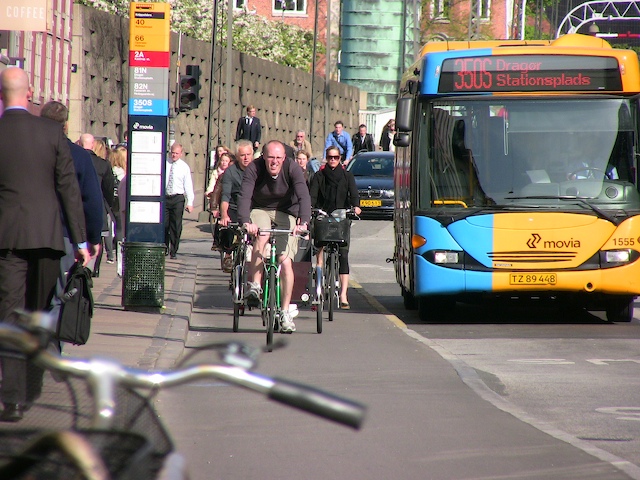
    But how can the Danish do this? Because their transportation infrastructure has been configured a good deal around bikes. Streets have been changed for maximum bicycle freedom and not cars and trucks. Pedestrians have more space and are less likely to be injured. Rush hour is nice to get around. Look at right. All of this enables 36% of Copenhageners to get to work or school by bike with the goal of 50% by 2015 (see here).

    And you know what? On all measures of health, wealth, and well-being, the Danish outscore almost everyone. On my new favorite index, the Happy Planet Index, Denmark has a Life Satisfaction score of 8.1 out of 10. That's higher than France, Germany, Canada, the United States, Sweden, Australia, and Japan. It's tied for happiest with Norway and Ireland. As far as I can tell, the only country that has been measured higher is Costa Rica which has an 8.5. As a side note, Costa Rica has the coolest bike race in the world, the "Ruta de los Conquistadores." Totally insane. But I digress.

    Riding a bike correlates with happiness and health. Danes are invested in being happy, healthy, invested in their communities, and invested in the health of the planet. Not just money. Methinks we have something to learn here.

    Lessons here for schools.

    Exercise? Check. Enjoy the outdoors? Check. Time for reflection? Check. Reduced ecological footprint? Check. A tool for teaching about history, math, physics, material sciences, design, engineering, maintenance, and caloric output? Big checks all around.

    I think we have a teaching tool! Here's a nutty idea: maybe American school children should be given bicycles instead of laptops. Now that would be radical.

    Monday, December 7, 2009

    No bottled water at the Copenhagen Climate Summit

    That's right. This in from Tap It.
    Organizers are trying to make the Copenhagen Climate Summit as 'green' as possible and one of the first things they targeted - bottled water. If that isn't enough to convince you the stuff is bad news, I don't know what is!

    Instead of refrigerators full of bottled water, delegates are being offered ordinary Copenhagen tap water from biodegradable corn starch cups filled from drinking fountains dotted around the Bella Center convention hall.

    They're also cutting down on transportation. There are no special buses laid on. Instead participants will be encouraged to use public transport links serving the venue. Bicycles are also available and high-level delegates are being offered limousines powered by ethanol made from organic waste.


    Copenhagen Climate Summit Opens

    After the basic failure of the climate negotiations in Bali, we have the next round now unfolding in Copenhagen, Denmark. In the coming two weeks, political leaders, ambassadors, scientists, et al will be trying to craft a global framework within which nations can address their role in the emerging climate crisis and hopefully create binding resolutions for caps on emissions.

    To get a full read on this story, you can peruse any number of sites to get different reads on this. BBC. New York Times. The Guardian. Times of India. Der Spiegel. Grist. Treehugger. DotEarth. For great ethical backdrop on why and how these negotiations consider issues of fairness, justice, and action in the face of uncertainty you can go to Climate Ethics. Climate science from climate scientists? Real Climate.

    This summit is creating an enormous and encouraging wave of political goodwill. Of course, there is an army of so-called "skeptics" out there protecting business as usual so that polluting industries and power brokers can keep polluting and ruining the livelihoods of tens of millions of people in coming years. But they are losing power and with concerted action people here and now can, in word and deed, make a difference.

    Vote on this issue and press your representation on it. Change how you use electricity, how you eat, and the way you get around. Teach for sustainability.

    As two of our members have just returned from or are currently living in Sweden, let's use a Swedish ad on climate change to get the point across.

    I'd rather have someone driving that car well.