Here we go again, not surprisingly- Nestle continues the push to privatize water. And also, not surprisingly, we continue to fight back! Here is a link to sign a Corporate Accountability International petition to Nestle's CEO, Kim Jeffery: http://salsa.democracyinaction.org/o/2215/p/dia/action/public/?action_KEY=6433.
(Note: it's been a while since I've posted and I can't remember how to insert a hyperlink! Please excuse my blog illiteracy.)
Showing posts with label Plastic Bottles. Show all posts
Showing posts with label Plastic Bottles. Show all posts
Thursday, June 9, 2011


Tuesday, February 22, 2011
Let's Take Back the Tap
Now that we've got the infrastructure going better for reusable bottles at Penn State, let's see about getting rid of Aquafina again.

We have a petition up calling on President Spanier and the Board of Trustees to stop selling Aquafina at Penn State. It reads:
Dear President Spanier and the Board of Trustees,So take a minute if you are a Penn Stater and sign this petition. Let them know that we want accountability and responsibility.
We the undersigned believe that Penn State should cease buying and selling single-use plastic water bottles immediately. The detrimental costs associated with single-use bottles are numerous.
Single-use plastic water bottles contribute to solid waste pollution when they aren’t recycled. In all parts of their lifecycle they contribute to climate change. They needlessly exploit a public resource for a price-gouging venture that charges about 700 times the price of tap water at Penn State. Finally, the EPA’s standards on municipal drinking water are more stringent than the FDA’s regulating bottled water.
With Penn State’s growing commitment to sustainability, it doesn’t make sense to carry on business as usual. Around campus, our Office of Physical Plant has installed bottle-filling stations that grow more popular every week. More students, staff, and faculty are moving away from single-use plastic bottles and using reusable steel, aluminum, and plastic canteens and bottles.
We know that more people across our university want good water. We have it.
We know that smart people are responsibly drinking water from our Spring Creek watershed.
We call on you not to renew the Aquafina contract with Pepsi and move us bottle free!!!
We are Penn State.
Tuesday, November 30, 2010
Fiji fights Fiji
 That's right. Fiji water*, one of the most overpriced single-use plastic water bottle companies is in trouble with the Fijian government. MSNBC, AlterNet, and others are reporting that there is a dispute on taxes between the corporation and the military junta government.
AlterNet reports:
It seems there is trouble in paradise. The boutique bottled water brand Fiji Water has announced that it is shutting down its operations in Fiji after the nation's government proposed a tax hike -- from 1/3 of a cent to 15 cents a liter. This comes just a week after one of the company's top executives, David Roth, was deported.Ouch. On the one hand, how great is it that there is less bottled water coming from one of the worst collusions in corporate-governmental history. But how terrible is it that the junta will sell it to some other corporation to come in and exploit the people and the ecosystem in which they live to sell overpriced water primarily to people who don't need it but are stuck believing in a manufactured need for "convenient" and "glamorous" "Artesian water?" Companies like Coke, Pepsi, Nestle, Violia, Suez, and Thames are probably going to scramble all over each other to get at this one.
I'm with Maude Barlowe and Wenonah Hauter of Food and Water Watch who say the closure should be permanent. At Food and Water Watch today they write the following:
“Like oil in the 20th century, water has become increasingly managed by corporate cartels that move it around the globe, where it flows out of communities and towards money. The commodification of water will continue to contribute to human rights abuses around the world, whether it helps bolster undemocratic governments or drives water from a community where it is needed.
“Water must be managed as a common resource, not as a market commodity. Unfortunately, celebrities, sports figures and American consumers pay a premium for the Fiji Water brand, buying it at approximately 3,300 times the cost of U.S. tap water. According to the EPA, a gallon of tap water costs consumers anywhere from .002 to .003 cents. A liter of Fiji Water costs approximately $2.19.
“Ironically, Fiji Water, Coca-Cola and PepsiCo have been named finalists for the Secretary of State’s 2010 Award for Corporate Excellence. It would be extremely unwise for Secretary of State Hillary Clinton to honor these corporations, which have been known to extract water from developing countries that are facing water scarcity or that otherwise cannot meet residents’ needs for clean water and sanitation.”
Hear here! Are you going to walk away from bottled water? Do it. And tell Take Back the Tap that you are on board by signing the pledge.
Hat tip to Vince and Jess for this one.
* You have to love the sound of the tropical rain forest coming through your computer to show you just how free and unblemished that water is. If only corporations really protected the wild that much. Maybe they'd leave the water there for the wildlife and the people. Just a thought.
Wednesday, November 24, 2010
And the movement just keeps getting bigger
Do you know how many people are fed up with bottled water? Millions. And lots of people are getting together in all kinds of configurations to do something about it.
Yes! Magazine has this feature:
Yes! Magazine has this feature:
Restaurants in California, Oregon, New York, Maine, and other states are serving only tap water. Students at Brown University were inspired to start Beyond the Bottle after Washington University in St. Louis ended sales of bottled water on its campus.
Seattle University and Gonzaga University in Washington state, and the University of Portland in Oregon, have also ended sales of bottled water. Multnomah County became the first county in Oregon to ban bottled water from county meetings and functions. Efforts to prevent a bottling company from extracting millions of liters of water from the local aquifer led the city of Bundanoon, Australia, to ban the sale and production of bottled water. Toronto, London, and other cities in Ontario, Canada as well as school boards in Ottawa and Waterloo have stopped the sale of bottled water in municipal facilities.
Bottled water is marketed as superior to tap, but public water supplies are actually cleaner, less expensive, and more environmentally responsible, according to organizations like Take Back the Tap, Food and Water Watch, and Stop Corporate Abuse. They are mounting campaigns to combat misconceptions caused by bottled-water marketing.
That's right. Take back that tap. In the near future, we'll be expanding our work on this with some film projects, a musical project, and other humorous theatrics. Stay tuned!
Thursday, September 30, 2010
10 bottle filling stations at Penn State University Park
There are now 10 bottle-filling stations across campus! Though it's still technically in its pilot phase, it looks as though these things are going to stay. After getting a ton of emails this past spring requesting a machine or information on how to get them, I've been so happy to see new ones installed. That's fewer single-use plastic bottles in landfills.
In fact, this morning I used the Pattee Library bottle station. Its meter read over 24,000 plastic bottles saved! Yesterday I used the one in Chambers - over 10,000 bottles!
In fact, this morning I used the Pattee Library bottle station. Its meter read over 24,000 plastic bottles saved! Yesterday I used the one in Chambers - over 10,000 bottles!
Tuesday, September 14, 2010
Explaining the logic of the plastic bottle greenhouse
These are some explanations of the greenhouse's purpose and our thinking behind it.
Part I
Part II
Part I
Part II
Tuesday, August 31, 2010
League of Women Voters to tackle bottled water
The Centre County chapter of the Pennsylvania League of Women Voters is holding a panel discussion on the effects of plastics and other chemicals on human health. One of our most consistent allies, Lydia Vandenbergh from Penn State's Office of Sustainability, will lead things off.

Read the rest of the release here.Plastics, Pesticides, and Pharmaceuticals: Understanding the Potential Health Risks to Ourselves and Our Children
State College, Pa—Did you know that many plastics, pesticides, and pharmaceuticals contain harmful chemicals such as BPA that can disrupt our hormone systems? What are these harmful chemicals and how can we protect ourselves and our children from them?
A panel discussion, hosted by the League of Women Voters of Centre County, will answer these and other questions. The panel discussion—which will be held on September 15, 2010 at 7:00 p.m. at the State College Borough Council Chambers located at 243 South Allen Street, State College, PA 16801—will feature keynote speaker John Vandenbergh, a professor emeritus of biology at North Carolina State University, who is an expert on endocrine-disrupting compounds (EDCs) and their human health risks. Also, presenting research on remediation of EDCs will be Rachel Brennan, an assistant professor of civil engineering at Penn State, as well as the following local water officials: Max Gill, the executive director of the State College Borough Water Authority, Cory Miller, the executive director of the University Area Joint Authority, and James Baird, a utilities system engineer at Penn State. EDCs mimic or block the action of natural hormones in our bodies. Research suggests that they may cause a host of reproductive problems in animals and humans, such as cancer of the reproductive organs and the early onset of puberty. Babies and young children are particularly at risk.

Thursday, August 26, 2010
The greenhouse is finished
Hey biophiles! Look! It's finished! Becky M went with her husband and attached the roof. It looks beautiful! I think we owe Becky and her family a lot of praise and thanks.


Wednesday, August 25, 2010
Responding to Nestle
3E-COE president Peter Buckland responds to a Nestle employee who has argued for bottled water in the campus paper.
---
To the editor:
Yesterday, Nestle employee Tom Uhl argued that “bottled water is actually a better environmental choice than other packaged beverages.” Newsflash: water is better for you than soda full of chemical additives and high fructose corn syrup. Uhl’s argument is a distraction.
From beginning to end, the more than 50 billion bottles of water sold in the United States wreak environmental, social, and economic havoc.
First, it takes 1.85 gallons of water to manufacture one bottle of water – more than 14 times the amount of water finally delivered in a 16 oz. bottle itself. Why waste so much water?
Second, bottled water is fossil fuel intensive through its production, transport, cooling, and its disposal. Why waste so much oil to move water around?
Third, with a national plastic recycling rate of between 17% and 20%, I hardly think that we can call this a good environmental choice. Why waste so much plastic?
Finally, bottled water commodifies a biological need. It puts water into a “beverage” (it is still water isn’t it?) for “on-the-go” people (what are we hamsters in wheels?) at a price 700 to 10,000 times that of municipal water. Who profits? Not local communities and economies and the bioregions in which they live. It lines the pockets of already excessively rich people who have no right to that water. Why waste the money?
So do your part – grab a reusable bottle or cup and drink essentially free water from our Spring Creek Watershed.
---
To the editor:
Yesterday, Nestle employee Tom Uhl argued that “bottled water is actually a better environmental choice than other packaged beverages.” Newsflash: water is better for you than soda full of chemical additives and high fructose corn syrup. Uhl’s argument is a distraction.
From beginning to end, the more than 50 billion bottles of water sold in the United States wreak environmental, social, and economic havoc.
First, it takes 1.85 gallons of water to manufacture one bottle of water – more than 14 times the amount of water finally delivered in a 16 oz. bottle itself. Why waste so much water?
Second, bottled water is fossil fuel intensive through its production, transport, cooling, and its disposal. Why waste so much oil to move water around?
Third, with a national plastic recycling rate of between 17% and 20%, I hardly think that we can call this a good environmental choice. Why waste so much plastic?
Finally, bottled water commodifies a biological need. It puts water into a “beverage” (it is still water isn’t it?) for “on-the-go” people (what are we hamsters in wheels?) at a price 700 to 10,000 times that of municipal water. Who profits? Not local communities and economies and the bioregions in which they live. It lines the pockets of already excessively rich people who have no right to that water. Why waste the money?
So do your part – grab a reusable bottle or cup and drink essentially free water from our Spring Creek Watershed.
Monday, June 21, 2010
Plastic greenhouse redux on 6.21.2010...the longest day of the year
In case you were wondering about what is happening with the plastic bottle greenhouse, here is an update. We have a roof frame with bottles on the outer edge...
 ...and they look really cool with the sun behind them...
 ...and now it also has some of the roof complete...

...and soon it will be up on the frame with the whole shebang in order.
 See you soon.
 ...and they look really cool with the sun behind them...
 ...and now it also has some of the roof complete...
...and soon it will be up on the frame with the whole shebang in order.
 See you soon.
Tuesday, June 8, 2010
Plastic bottle greenhouse update - Two walls up! Door on next wall that's nearly ready for mounting!
In the continuing saga of the Corl Street Elementary School plastic bottle greenhouse...we have some more progress. Over Memorial Day weekend, Becky and her husband Vilmos finished a wall that I got to put up yesterday and tie the bottles together for support.

Today, another wall frame was finished and the door put on with Zach (in the picture with the door).

So this thing is coming along. For me, the coolest thing has been talking to people about why I came up with this hair-brained idea and why we started doing it. We live with these bottles and really wish we could get rid of them. Barring that at this point, maybe we can exapt them for an educational, social, and ecological good. Why not use them to try to help grow food and increase awareness about the waste cycle and show how to reduce-reuse-recycle. Every teacher and parent that has talked to Becky or me about this is really into it. All of them want to make something that is both "cool" and instructive for sustainability.
 In a few more installments of work, we'll have all the walls up and then we'll get to work on the roof. Enjoy the pictures.


Today, another wall frame was finished and the door put on with Zach (in the picture with the door).

So this thing is coming along. For me, the coolest thing has been talking to people about why I came up with this hair-brained idea and why we started doing it. We live with these bottles and really wish we could get rid of them. Barring that at this point, maybe we can exapt them for an educational, social, and ecological good. Why not use them to try to help grow food and increase awareness about the waste cycle and show how to reduce-reuse-recycle. Every teacher and parent that has talked to Becky or me about this is really into it. All of them want to make something that is both "cool" and instructive for sustainability.
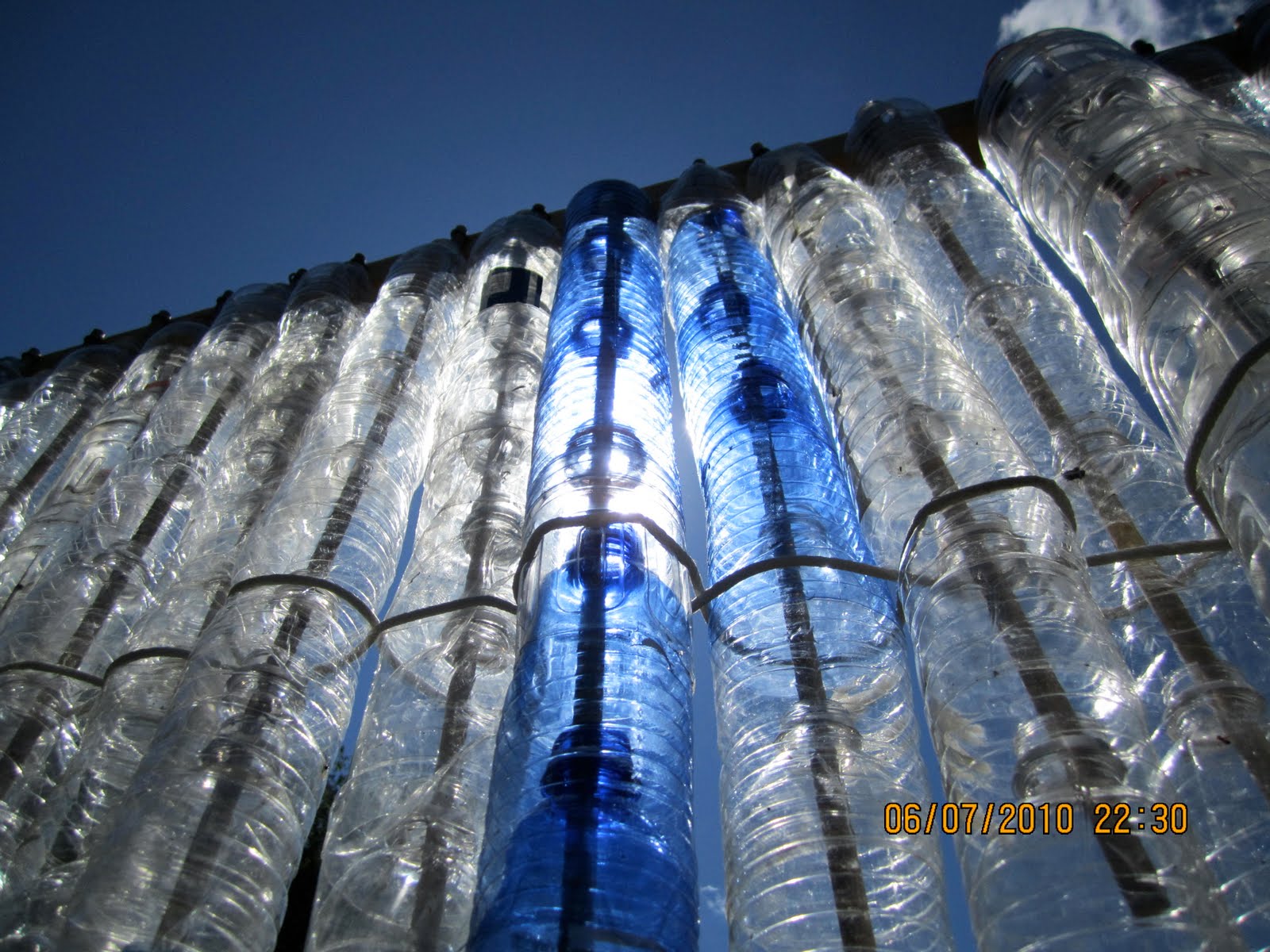 In a few more installments of work, we'll have all the walls up and then we'll get to work on the roof. Enjoy the pictures.
Monday, May 17, 2010
Greenhouse update...weeks later
The saga of our plastic bottle greenhouse continues...
Today, about 10 parents of children who attned the Corl Street Elementary School in State College worked with 2 members of 3E and a scad of third graders to get us to the next phase. We washed, cut, and sorted a few thousand more bottles while the physical plant guys for the district planted the posts and poured the concrete to set them in. Because the concrete has to set and part of the wall frame was used for it, we couldn't carry on with the frame and fix bottles to it.Kind of a bummer but so it goes. It started raining heavily anyway so it's not so bad that I've gotten to come back in.
That said, I am blown away by two things
[To track back go here, here, and here.]
Today, about 10 parents of children who attned the Corl Street Elementary School in State College worked with 2 members of 3E
 and a scad of third graders to get us to the next phase. We washed, cut, and sorted a few thousand more bottles while the physical plant guys for the district planted the posts and poured the concrete to set them in. Because the concrete has to set and part of the wall frame was used for it, we couldn't carry on with the frame and fix bottles to it.Kind of a bummer but so it goes. It started raining heavily anyway so it's not so bad that I've gotten to come back in.
That said, I am blown away by two things
1. Those third graders are awesome. They were enthusiastic while they washed and cut bottles, sorted them, and cut dowel rods. Our own Becky M. made this whole fun workstation thing and the children worked together on it so well. Some of them came back during recess to help us. I was personally pretty touched.We should have some pictures pretty soon to show some more of this. Once the weather clears, I'll be heading over in the mornings to put the frame up piece by piece.
2. Holy giant amount of work that uses a giant amount of junk! I said in a previous post, "I am personally dumbfounded by the sheer volume of bottles we’ve gotten from the Office of Physical Plant’s bar pit. And these are the bottles that have been recycled. For every bottle that we’ve gotten from the recycling here, another one was probably thrown away." Putting that sheer volume into workable shape using just ordinary tools (water, soap, scissors, razors, dowel rods, nails/fencing staples, hammer, nails, screws, and power drill) is pretty crazy. I'm thinking that today's pure human work hours is somewhere around 50.
[To track back go here, here, and here.]
Monday, April 26, 2010

Saturday, April 24, 2010
Plastic bottle greenhouse door: Update #3
 So we have a door for this plastic bottle greenhouse now (see the explanation video here). Here it is on the ground of the HUB lawn. Monday, I'll be working on sides, crossbars, and the larger frame. Phew!
Look at how many bottles are in that picture alone...about 200-250. All told, we will end up reusing something like 2000 in this project which is somewhere near half of of the daily recycled bottles that Penn State University Park's Office of Physical Plant collects, which is itself just over 1/2 of the total that PSU University Park disposes of every day. This total rough estimate leads me to believe that we could make 600-700 of these 5'x5'x6' gabled plastic bottle greenhouses out of just PSU University Park's recycling. That's a lot of waste.
We met a few parents today who were really into this thing. A few were from the Corl Street Elementary School who had heard about it and thought that it at least looked cool. Moreover, they said that they thought it was a really interesting way for their kids to engage their schooling. They were also quite interested in sharing, and having their kids share, how they are engaging the natural environment at school via the garden, the 3 Rs of Reduce-Reuse-Recycle, and composting. One girl said that she wants one at her school - the Gray Wood's Elementary. That sounds great, but we might need this to be a full-time job with benefits if it gets to that point.
Stay tuned for more.
Pic courtesy of Garrett.
Kid's Earth Day

Come on out and bring kids for a fun and beautiful day. Like the flier says, there are some great activities in store for everyone, including an enactment of Dr. Seuss's The Lorax. We'll be there, putting a portion of the plastic bottle greenhouse together. More pictures will be on the way.
Friday, April 23, 2010
Bottle greenhouse update #2
Wow! This thing is incredible and it's taking SOOOO much time. We've cut and washed well over a thousand bottles and have more to go. The frame is still unfinished and won't be for a few days just because the sheer size of the project required more people than we were able to muster. But you know what? We're moving along and we'll keep plugging away for the rest of the semester.
We will post more pictures soon and possible video soon.
To hear a story on some Earth Day activities, listen to this story put together by the Ohio River Radio Consortium that includes two of our members, Garrett Eisenhour and Jason Usdin, as well as people in Indiana and Kentucky.
To see some more of it come alive, come to Kid's Earth Day tomorrow, April, 24th, at the HUB lawn.
We will post more pictures soon and possible video soon.
To hear a story on some Earth Day activities, listen to this story put together by the Ohio River Radio Consortium that includes two of our members, Garrett Eisenhour and Jason Usdin, as well as people in Indiana and Kentucky.
To see some more of it come alive, come to Kid's Earth Day tomorrow, April, 24th, at the HUB lawn.
Thursday, April 22, 2010
The bottle house! Update one
Our greenhouse is really in full swing. We have THOUSANDS of bottles that we’ve been washing, cutting, and arraying into lines to form the house’s walls. We’ve done just some starts to fix them to the frame to start and it’s looking promising.
 A few things are striking at this point:
1. People are impressed by this idea. Moms have walked by with kids and given us bottles to use.
2. Everyone who we tell that this is going to be used by a school has congratulated us. This is smart. A lot smarter than the intended use of the bottles themselves.
3. Wow! People at Penn State create a lot of waste. I am personally dumbfounded by the sheer volume of bottles we’ve gotten from the Office of Physical Plant’s bar pit. And these are the bottles that have been recycled. For every bottle that we’ve gotten from the recycling here, another one was probably thrown away.
 4. This is fun and it’s community-building. We’re meeting people we haven’t met before. A Corl Street School mother and her 14-year-old son came by and helped. We have future teachers. We have passersby. The HUB lawn today has been a commons for people interested in furthering sustainability and education for sustainability.
5. Our group has rerouted something from upstream that would have gone downstream to further commodififcation or ugliness and turned it into something that can be potentially beautiful, useful, and good!
So come on by today and/or Saturday April 24th to the HUB lawn and help us reuse for a better tomorrow.
 A few things are striking at this point:
1. People are impressed by this idea. Moms have walked by with kids and given us bottles to use.
2. Everyone who we tell that this is going to be used by a school has congratulated us. This is smart. A lot smarter than the intended use of the bottles themselves.
3. Wow! People at Penn State create a lot of waste. I am personally dumbfounded by the sheer volume of bottles we’ve gotten from the Office of Physical Plant’s bar pit. And these are the bottles that have been recycled. For every bottle that we’ve gotten from the recycling here, another one was probably thrown away.
 4. This is fun and it’s community-building. We’re meeting people we haven’t met before. A Corl Street School mother and her 14-year-old son came by and helped. We have future teachers. We have passersby. The HUB lawn today has been a commons for people interested in furthering sustainability and education for sustainability.
5. Our group has rerouted something from upstream that would have gone downstream to further commodififcation or ugliness and turned it into something that can be potentially beautiful, useful, and good!
So come on by today and/or Saturday April 24th to the HUB lawn and help us reuse for a better tomorrow.
Monday, April 5, 2010
Bottle stations on the local nightly news and a story in the paper all in one day
Wow. When it rains, it really really pours...from our bottle-filling stations. Check out this piece on local WTAJ TV...
For the record, I think that Lydia Vandenberg and I should form a band about water. Name ideas?
UNIVERSITY PARK, CENTRE COUNTY - Last year, Penn state installed its first water bottle filling station in the HUB Student Union, this year the school has added three more at Chambers Building, the Intramural Building, and Willard Building at University Park....and then this piece in the Centre Daily Times.
The university sells $2.7 million worth of bottled water each year, and is one of the first in the nation to offer this high tech thirst quenching technology.
“One of the most needless forms of waste that we have comes from non-reusable disposable plastic water bottles,” Peter Buckland, a PhD candidate at Penn State who helped spearhead the initiative to get the filling stations on campus, said.
Check out the comments on the CDT page too. Some of those are real keepers.“We are using this to investigate water bottle filling stations,” said Lydia Vandenbergh, program coordinator at the campus sustainability office. “We did some testing by the environmental health and safety group to make sure the stations would not be a breeding ground for bacteria.”
A club called 3e-coe, composed of education majors and self-proclaimed Earth lovers, had urged the Office of Sustainability to stop purchasing bottled water to sell on campus.
“The club was great. They were kind of the ones that came to university and said let’s ban water bottles,” said Vandenbergh. “The university spends about $2 million on water bottles in their contract with Pepsi. ... The club came to us with a black-and-white proposal, but we were able to work with them to find what’s the best for Penn State.”
For the record, I think that Lydia Vandenberg and I should form a band about water. Name ideas?
Wednesday, March 24, 2010
Spanier notes us in the Board of Trustees speech
All. Check it out from President Spanier.
I'm proud to report another student accomplishment — this one on our University Park campus. Thanks to the work of a student ecology group from the College of Education, we're experimenting with new drinking water filling stations around campus. These sensor-activated filling stations accommodate reusable drinking cups and larger containers. The group collaborated with the Office of Physical Plant to install the new hydration stations as well as to upgrade some of the college's water fountains. The intention is to reduce the use of disposable plastic bottles, which will reduce our environmental footprint and keep our campus clean.Now we're getting somewhere. Maybe we can go to a meeting sometime. That would be nice.
Subscribe to:
Posts (Atom)