Showing posts with label Gardens. Show all posts

Monday, March 7, 2011

Five Schools Implementing Community Garden Projects

This is a guest post by Katheryn Rivas, a freelance writer and blogger.


---


As the threat of climate change continues to sink in to our collective psyches, this generation has had to slowly un-learn everything we became accustomed to in an effort to reduce our carbon footprint. The climate-conscious have done away with gas-guzzling SUVs in favor of hybrid or electric vehicles, switched out their light bulbs, learned to recycle, and learned to shop locally.

With a little help, the next generation of young people won't have as much un-learning to do. Parents, teachers, administrators and the greater community who want to instill principles of sustainability into the next generation can start with the children under their care. One way of doing so is by implementing community gardens in neighborhood schools. Here we'll discuss five schools that are implementing community garden projects to teach children about nature, the environment and what it means to grow one's own food.


1.) Mount Kisco Elementary School.

This public K-5 school in Mount Kisco, NY, is planting its first community garden this spring with the generous financial backing of a community partner, the Bedford Garden Club. Not only will members of the garden club act as master gardeners to the children who will learn from the project, but the community as a whole will be able to grow food there too. Children will learn how to garden, compost and irrigate using rain barrels. The garden, which will grow tomatoes, lima beans, snap peas, radishes, sunflowers and herbs, may be used in the future to launch an after-school cooking program. Read more about this community garden in Chappaqua-Mount Kisco Patch.


2.) Martin Luther King, Jr. Middle School.

This urban public school in Berkeley, Calif., benefits from a program several years in the making called the Edible Schoolyard, a one-acre organic garden where they learn how to grow, harvest and prepare produce. The community partner here is a nonprofit called the Chez Panisse Foundation. The garden includes berries, herbs, fruits, veggies and flowers. There's even an adjacent kitchen classroom where students learn to cook using the produce they harvest. Most recently the project has taught children about sustainability through a Rainwater Catchment System. Read more about this education garden at the Edible Schoolyard Website.


3.) Waupaca Community/School Garden.

This community garden is situated on property owned by the School District of Waupaca in east central Wisconsin and is truly a collaboration among local businesses, nonprofits, a local school district and individuals. Not only is the garden used as an outdoor classroom and educational tool for area schools, but the community uses it to supplement the Waupaca Food Pantry with fresh produce. The community garden grows herbs, fruits and veggies like basil, squash, zucchini, cantaloupe and sweet corn. Read more about this community garden on the school district's website.


4.) The Wheeler School.

This independent day school in Providence, RI, has an organic garden where students learn to grow food and that also contributes food to the RI Community Food Bank. The garden not only provides a chance for children to get their hands dirty learning to plant and harvest food, but it also produced more than 200 pounds of organically-grown produce for the food bank in 2010. Learn more about the Wheeler School's garden through its blog.


5.) Carmel Middle School.

This school in Carmel, Calif., teaches kids about sustainability alongside the basics of gardening using a program called MEarth and an organic garden situated on the nearby Hilton Bialek Habitat. Kids learn about native plants, habitat restoration, climate change, cooking and nutrition, and waste and recycling through this program. The program also invites the wider community in through open volunteer days. Learn more about how the garden helps in the education process at Center for Ecoliteracy and the Carmel Habitat.

By-line:

This guest post is contributed by Katheryn Rivas, who writes on the topics of online universities which discusses about education, students life, college life, career and eco living. She welcomes your comments at her email Id: katherynrivas87@gmail.com.

Tuesday, September 14, 2010

Thursday, August 26, 2010

The greenhouse is finished

Hey biophiles! Look! It's finished! Becky M went with her husband and attached the roof. It looks beautiful! I think we owe Becky and her family a lot of praise and thanks.


Tuesday, June 8, 2010

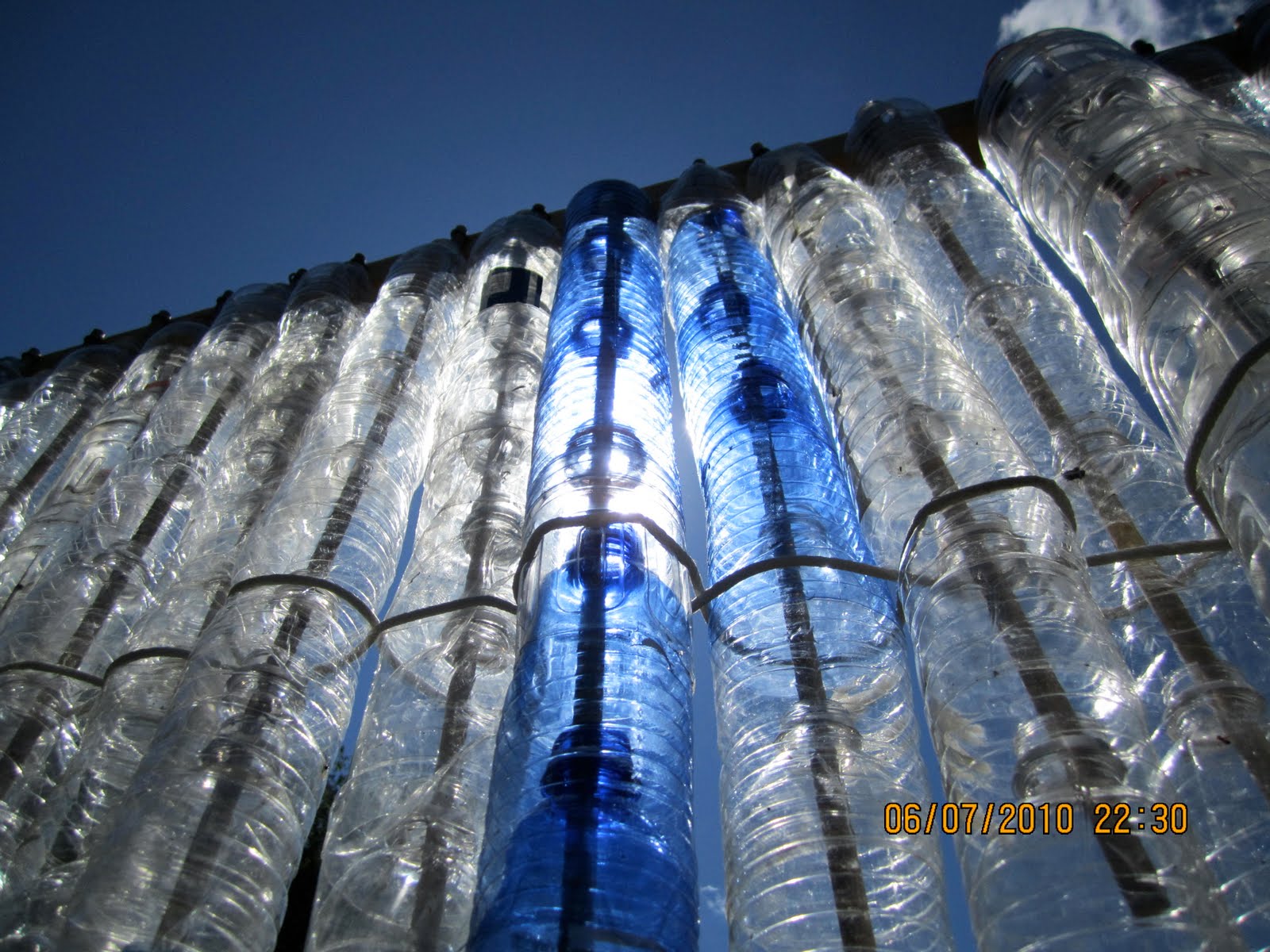
Plastic bottle greenhouse update - Two walls up! Door on next wall that's nearly ready for mounting!

In the continuing saga of the Corl Street Elementary School plastic bottle greenhouse...we have some more progress. Over Memorial Day weekend, Becky and her husband Vilmos finished a wall that I got to put up yesterday and tie the bottles together for support.


Today, another wall frame was finished and the door put on with Zach (in the picture with the door).


So this thing is coming along. For me, the coolest thing has been talking to people about why I came up with this hair-brained idea and why we started doing it. We live with these bottles and really wish we could get rid of them. Barring that at this point, maybe we can exapt them for an educational, social, and ecological good. Why not use them to try to help grow food and increase awareness about the waste cycle and show how to reduce-reuse-recycle. Every teacher and parent that has talked to Becky or me about this is really into it. All of them want to make something that is both "cool" and instructive for sustainability.

In a few more installments of work, we'll have all the walls up and then we'll get to work on the roof. Enjoy the pictures.

Friday, February 19, 2010

Brooklyn School Farmyard

Check this out guys.

Food. We love it and can’t live without it. It keeps us happy, healthy, and smart. We’re making local, organic food available to everyone, one yard at a time. And we need your help to keep the mission alive.

Based in Brooklyn, BK Farmyards transforms under-utilized land into tasty edible landscapes. We partner with homeowners, schools, developers, and community members to build micro-farms and distribute produce weekly. Not only can the community follow the food from seed to table, they are helping us build a much-needed alternative to the abundance of cheap processed foods and fast-food restaurants. We rely exclusively on the power of volunteers and the endless energy of the bk team instead of gas-guzzling machinery. We strive to make our food so affordable that anyone can access fresh food.

In 2009, we have done so much with so little, feeding 6 people for 12 weeks off of 600 square feet in Ditmas Park, Brooklyn. A lot of people really loved the idea: visit a video of Foxtrot, our first micro-farm http://www.vimeo.com/6137263

If you'd like to donate to the project or learn more go to this link.

Wednesday, September 23, 2009

Peak Moment

YouTube. That vast bastion of silly videos. Not just so.

I have come upon an interesting YouTube channel called Peak Moment. They describe themselves as follows:
Peak Moment is a weekly series showcasing perspectives and initiatives for local self-reliant living. Programs feature host Janaia Donaldson's conversations and on-site tours with guests preparing for accelerating energy decline, climate chaos, and economic uncertainty.

Sample topics include: local food production; renewable energy; transportation alternatives; sustainable building; personal, economic, business, and governmental responses.
I've gotten to peruse some of the programs they've aired and found them to be pretty interesting. With 158 posted videos, there's an awful lot to watch and contemplate, but my searches yielded some nice stuff including...you guessed it: school gardens.
Take a tour with team-teachers Glenda Berliner and Jeralyn Wilson, as they show us their elementary school garden bearing many fruits. It's an important part of the curriculum: children make mason bee boxes, grow colonial medicinal plants, learn of other cultures, and put science to work. It builds community: parents work together, students form a bucket brigade to transport wood chips. It's a site for celebrations like a pumpkin harvest or a play. Whether it's the flower and vegetable beds, or the restful Zen garden, this spot has become a favorite place to be, and to grow from.


Three things emerge for me from this video. First, Berliner and Wilson understand and ground the garden in the community; they envisioned the garden as a community space that would be realized most of the time as a community for children and children with teachers that ripples out into the broader community. Second, they really envisioned the garden as a place nested within a place. Their school seems (and I am careful here) to be adapted to the northwestern Washington state environment and not vice versa. The garden is a place about these people's place. Finally, we can note that however briefly they discuss curricula, the garden permeates it. Phys ed class runs through the garden and art class uses gourds.

Gardens are quite literally places of invention and generation.

Tuesday, September 22, 2009

Support school gardens

Here's your chance to reinforce some good behavior by congress. Support Bernie Sanders' amendment to the Agriculture Bill that would give $2 million to school gardens! Click here to follow up with National Garden Association.

Thursday, May 28, 2009

"Cultivating Minds" from Edutopia and Sidebar Links Updates

Edutopia has a really nice article up titled "Cultivating Minds" on the advent of what Alice Waters calls the "Edible Schoolyard" and others call the "farm curriculum." Whatever we call it, it's gaining momentum and bringing teachers and children to consider our place in the biosphere as integral to schools. The article highlights a few of the star programs from around the country and bits and pieces about the programs they are implementing, from simple gardens where children find a purple heirloom carrot, to chickens that brought out the participation of Somali immigrant children, to some places that function on the order of farms. It is an invigorating read.

Problems lie ahead because legislators, policymakers, administrators, and teachers either don't know how or why food can be or should be so central to education because they might view at as some kind of narrow farmer-training program. As NCLB tells us and assumes, we are competitors in a "knowledge-based" global economy. What can this possible do to help us? That might be a difficult for some invested in narrow definitions of what schooling ought to serve.

But, the article makes a good point to show that this is about as broad-based a movement that exists and is growing. Josh Vertiel of Slow Food USA makes it clear, saying
We're giving away the right to teach our students to the most appealing bidder right now, and not the best teacher. And if we don't teach them what eating is, where food comes from, what health is about, and what it is to gather around the table, someone else is going to do it, and it's going to be someone who stands to make a profit. Instead, we should teach kids about what's good for them, what's good for the environment, and what's good for the people who are growing it.
This is just another way of saying what Wendell Berry has been saying for years, that every act of eating is an agricultural act. Food comes from somewhere and knowing where it has come from and how it has come to be is to know a great deal about one's self. To know one's food is to understand something about the very nature of the physical substance that makes up your body. Food has within it an ethical character that we can develop but are not when we invite Pizza Hut and Pepsi to run our school cafeterias. What these programs do is alter and recalibrate education such that the speed and scale of production shrinks and slows. It makes teacher and student, at least for a little while, into farmers and stewards of their own health and well being making them responsible for themselves and others. How Deweyan!

In other news, I have been loading the sidebar with some new links. I've updated some of the Pennsylvania links and the Education links with a bunch more to help us find curricular materials related to gardening, place-based education, our own region, and climate change issues. Check them out.

Wednesday, May 13, 2009

What does it really mean to teach in the 21st Century?

This is a special post from one of our members, Jenn Recant. She is a Penn State sophomore majoring in Elementary Education and a regular and vigorous attendee to 3E-COE's meetings.

---

While speaking with Dr. Richard Alley, a well-known scientist and professor at Penn State University, we discussed anthropogenic climate change and he stated, “you eat around 2,400 calories per day and you use about 240,000 calories per day - something does not add up” (link here for more). After listening to Dr. Alley I began thinking about what I had learned from him and how our lifestyles are unsustainable. I began to realize that what I have been learning about the environment not only applies to my life but also to what I will teach as a future educator. Teaching in the 21st century means teaching about current issues, and one of the leading problems that we are faced with today is that of environmental responsibility. Unsustainable living should no longer be an option. As teachers in this century, we cannot simply apply old methods of frontal learning and memorization and neglect crucial information about the earth we live on. We as teachers need to change some of the methods of teaching in order to engage our students with a hands-on, whole-child approach; teaching not only the basics but also about how to live our lives. Schools need to educate students at all grade levels about important and topical issues that they will need to address throughout life and as adults. Learning about the environment, problems that are occurring, and how to make positive changes are some of the most important topics of this century.

One of the key conclusions from the 2007 UN Intergovernmental Panel on Climate Change stated, “warming of the climate system is unequivocal and most likely anthropogenic”. The National Academy of Sciences agreed with this statement and there is little debate among scientists that global environmental changes are taking place. What does this mean for us as teachers in the 21st century? It means we need to take on the responsibilities that these changes will brings about.

The first step in mitigating the effects of climate change and eventually adapting a new lifestyle is teaching about the problems that the environment is currently faced with. Our process through the entire materials economy from extraction, production, distribution and consumption all the way to disposal is not a lifestyle that we can continue with. Our “throwaway economy” and our “story of stuff” that we are living with on our finite planet will not last. We as teachers have the power to change the future through our students. We can educate them on how to live sustainably with the foods we eat, the way we run businesses, the manner is which we use energy and much more. Climate change is becoming more and more dire; it will ultimately affect every aspect of our lives from social, political, physical to economic aspects. But how can we ever achieve that change if our school systems do not teach about the issues properly and our students do not learn what their futures hold?

This growing and changing process needs to start within the classroom with the teacher. In order to help teach the reality of issues and have our students become fully aware of the world around them, teachers need to get creative. We need to teach our students from a whole child perspective. We need to motivate our students into taking the right actions and have them become interested in the environment. It always seems as though students learn better when they are involved in interactive learning. There is currently a wealth of knowledge and experience that teachers can draw from including sample lesson plans from the internet, attending conventions that demonstrate teaching environmentally, and even new textbooks which provide sustainable living models that can help teachers achieve fresh ways to help their students connect to the environment. An article in The Boston Globe entitled “Put Climate Change in the Curriculum,” Queen Arsem-O’Malley discussed that the point of climate-change and environmental education is not to make sure that students can recite facts about carbon-emissions or biomagnifications, but students need to understand the science behind climate change and recognize that we can act now with the information we have. Students need to become more familiar with the general strategies we will use to lessen the impacts of climate change. Perhaps most importantly, students need to learn to think creatively about climate change, since innovative solutions will be necessary for one of the most challenging problems of our time.

This learning can and needs to take place at all grade levels and in all subject areas. Teaching environmentally can be challenging but it is a cross-disciplinary field that can be drawn into almost any subject or activity. Environmental education and use of active learning techniques in the classroom, such as creating learning centers or having a class garden can encourage children to eat nutritiously, allow them to participate in hands on and experiential learning, have social experiences, learn about leadership and participation, learn about nature and animals, and acquire life skills. Teachers can find help and get support through numerous organizations by approaching their superintendents, principals or civic associations. Organizations like The National Gardening Association have been providing material assistance to youth, community gardens and classroom gardens for the past two decades and have witnessed a growing interest. They encourage every grade level from K-12 to participate in garden learning and they try to help with funding and new ideas.

Though we cannot predict the future we know how important our earth is and that it is a major issue that the next generation will be faced with. As the National Science Board states, "The environment is a critical element of the knowledge base we need to live in a safe and prosperous world." Today's students will one day have to participate as citizens in making decisions regarding the environment, decisions that will be of lasting importance to themselves, their children and grandchildren, the nation, and of course, the planet. As teachers in the 21st century we need to implement green strategies into our classrooms, make our classrooms sustainable and motivate and teach our students about how to be conscious and eco-friendly throughout their lives.

Thursday, April 16, 2009

An edible schoolyard?

This makes me think we need a garden at the College of Education more than anything? How do teachers lead when we are ignorant? We don't.

So let's follow in the best way we can. Let's learn!


Friday, March 20, 2009

The White House Garden!

Guess what all? The New York Times reports that the White House will be installing an organic garden. And guess what?

It's for learning and teaching!!!

While the organic garden will provide food for the first family’s meals and formal dinners, its most important role, Mrs. Obama said, will be to educate children about healthful, locally grown fruit and vegetables at time when obesity has become a national concern.

In an interview in her office, Mrs. Obama said, “My hope is that through children, they will begin to educate their families and that will, in turn, begin to educate our communities.”

Twenty-three fifth graders from Bancroft Elementary School in Washington will help her dig up the soil for the 1,100-square-foot plot in a spot visible to passers-by on E Street. (It’s just below the Obama girls’ swing set.) Students from the school, which has had a garden since 2001, will also help plant, harvest and cook the vegetables, berries and herbs.
This is what we need. We have been calling for it and they have responded. Let's all take a moment and write to Dean Monk about our proposed teaching and learning garden and urge him to come on board as I did earlier this semester. I wrote:

School Gardens:
For the past year I have found that placed-based ecological education might best be accomplished with school gardens. Students who work in gardens find that they develop innate understandings of living things by cultivating flowers and vegetables, weeding, eating them, and sharing them with friends. Gardens naturally build community and interconnectedness with nature by making the place itself the learning environment. As John Dewey would note an educative experience must be connected and continuous such that a student can apply to her/his life outside of school. Gardens can and do break down artificial barriers between schooling, working, eating, and nature, thereby providing Dewey’s pleasurable and continuous educative experience.

Alice Waters, owner of one of San Francisco’s great restaurants Chez Panisse, has worked with the in Edible Schoolyard in Bay Area schools and the Garden Project. The Edible Schoolyard in Berkeley explains itself as follows:

The Edible Schoolyard, in collaboration with Martin Luther King Junior Middle School, provides urban public school students with a one-acre organic garden and a kitchen classroom. Using food systems as a unifying concept, students learn how to grow, harvest, and prepare nutritious seasonal produce. Experiences in the kitchen and garden foster a better understanding of how the natural world sustains us, and promote the environmental and social well being of our school community.
Waters notes the danger of leaving nature out of food as follows:
We’re losing the values we learned from our parents when we sat around our family table, when we lived closer to the land and communicated. The way children are eating now is teaching them about disposability, about sameness, about fast, cheap and easy. They learn that work is avoided, that preparation is drudgery.
The industrial food system that has arisen in post-World War II America has wreaked untold harm on domestic and international soil, air, water supply, and human bodies, brains, and attitudes. Convenience and its correlated drudgery avoidance has an American out-of-sight/out-of-mind attitude to food and its necessary energy costs that contributes to climate change.There is no single fruit from a proverbial tree of knowledge that can impart the knowledge to future generations that will help us undo environmental degradation. However, work with the living food we eat brings knowledge and care. All of the following can come from a garden: biology, botany, soil science, meteorology, solar science, math, aesthetics, preparation, self-sufficiency, and best of all conviviality. A well-prepared social studies teacher can easily teach about history, geography, or world cultures simply by using a sweet potato. The sweet potato and its relatives are used in today’s cuisine, indigenous North American Indian food, and indigenous South Americans and Africans for millennia. A simple vegetable becomes a throughway for learning about endless things. It shows the interconnectedness of all life and the integration of human lives through time. Just a yam can become Dewey’s superb “educative experience” that is both agreeable and transferable. Luckily for us, the State College area schools have already created school gardens. In fact, this past week the State College Area School District posted a website devoted entirely to gardens. Additionally, parents are moving to incorporate school gardens in Philipsburg and Penns Valley. It seems that Penn State is well behind the curve on this matter. It is my hope that the Penn State College of Education can remedy this and work to better future teachers’ experiences in school gardens.

Please send Dean Monk a note at dmh6@psu.edu. Maybe even point him to today's landmark (literally) announcement for planting this garden by the Obamas and the story in The New York Times. Please write nicely and assure him that this is something we not only want but need for a more sustainable future.

Thursday, February 5, 2009

PASA 2009

Hi all. I just want to say that I got to go to the PASA Conference today and had a really positive experience. This weekend I will post a more complete rundown of what I did and a couple of connections that I made. All in all, I think that the world of sustainability is doing well. People are developing consciousness and laying the groundwork for real change. At the institutional and governmental level we have a lot of work to do but I think that we are really in a good place at a good time because things are so bad...if that makes sense. The reality of stepping back and doing more on our own scales is setting in.

Just to show you what I mean, I post here a video by Roger Doiron of Kitchen Gardeners International about getting President Obama to put a garden on the White House lawn (something not without precedent):

Tuesday, February 3, 2009

Community Garden

Alright! The Center for Sustainability and Students for Sustainable Agriculture have posted the call for Community Garden applications (link is currently down).

In conjunction with the Center for Sustainability the club will be starting a community garden group and opening a community garden on April 18th, 2009. The site is located by Beaver Stadium off of Porter Road

Members of the group will recieve a 10X15 ft plots, with access to water, compost, and tools to encourage walking and biking to the site

The site is organic, but we will be offering workshops on organic methods for those not familiar the methods.

I'll be applying stat!