Friday, December 3, 2010

Learning Progressions, National Standards, and Environmental Science Literacy

This just in:

Waterbury Lecture

Learning Progressions, National Standards, and Environmental Science Literacy

Professor Charles W. (Andy) Anderson

Department of Teacher Education, Michigan State University

Anderson

December 9, 2010 11:00-1:00

Ballroom AB, Nittany Lion Inn

“Buffet Lunch Available Following Talk”

We are currently developing new national standards for science education. This gives us a rare chance to reconsider what is REALLY important in our science curriculum and teaching. This presentation focuses on research exploring two ideas. The first is "environmental science literacy:" We should prepare students who understand the environmental consequences of lifestyle, political, and economic decisions. The second is "learning progressions:" We should organize the curriculum around increasingly sophisticated ways of thinking about or understanding the most important scientific ideas and practices.

Charles W. (Andy) Anderson is Professor in the Department of Teacher Education, Michigan State University, where he has been since receiving his Ph.D. in science education from The University of Texas at Austin in 1979. He is past president of the National Association for Research in Science Teaching. He has been co-editor of the Journal of Research in Science Teaching and associate editor of Cognition and Instruction. He recently served as a member of NRC’s Committee on Science Learning, K-8 and of the NAEP Science Standing Committee, and NRC’s Climate Change Education Roundtable. His current research focuses on the development of learning progressions leading to environmental science literacy for K-12 and college students.

Contact Information: Jennifer Glasgow 814-865-180


Tuesday, November 30, 2010

Fiji fights Fiji

That's right. Fiji water*, one of the most overpriced single-use plastic water bottle companies is in trouble with the Fijian government. MSNBC, AlterNet, and others are reporting that there is a dispute on taxes between the corporation and the military junta government.

AlterNet reports:
It seems there is trouble in paradise. The boutique bottled water brand Fiji Water has announced that it is shutting down its operations in Fiji after the nation's government proposed a tax hike -- from 1/3 of a cent to 15 cents a liter. This comes just a week after one of the company's top executives, David Roth, was deported.
Ouch. On the one hand, how great is it that there is less bottled water coming from one of the worst collusions in corporate-governmental history. But how terrible is it that the junta will sell it to some other corporation to come in and exploit the people and the ecosystem in which they live to sell overpriced water primarily to people who don't need it but are stuck believing in a manufactured need for "convenient" and "glamorous" "Artesian water?" Companies like Coke, Pepsi, Nestle, Violia, Suez, and Thames are probably going to scramble all over each other to get at this one.

I'm with Maude Barlowe and Wenonah Hauter of Food and Water Watch who say the closure should be permanent. At Food and Water Watch today they write the following:

“Like oil in the 20th century, water has become increasingly managed by corporate cartels that move it around the globe, where it flows out of communities and towards money. The commodification of water will continue to contribute to human rights abuses around the world, whether it helps bolster undemocratic governments or drives water from a community where it is needed.

“Water must be managed as a common resource, not as a market commodity. Unfortunately, celebrities, sports figures and American consumers pay a premium for the Fiji Water brand, buying it at approximately 3,300 times the cost of U.S. tap water. According to the EPA, a gallon of tap water costs consumers anywhere from .002 to .003 cents. A liter of Fiji Water costs approximately $2.19.

“Ironically, Fiji Water, Coca-Cola and PepsiCo have been named finalists for the Secretary of State’s 2010 Award for Corporate Excellence. It would be extremely unwise for Secretary of State Hillary Clinton to honor these corporations, which have been known to extract water from developing countries that are facing water scarcity or that otherwise cannot meet residents’ needs for clean water and sanitation.”

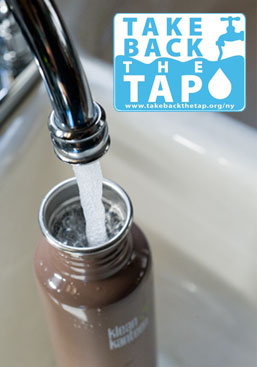
Hear here! Are you going to walk away from bottled water? Do it. And tell Take Back the Tap that you are on board by signing the pledge.

Hat tip to Vince and Jess for this one.

* You have to love the sound of the tropical rain forest coming through your computer to show you just how free and unblemished that water is. If only corporations really protected the wild that much. Maybe they'd leave the water there for the wildlife and the people. Just a thought.

Saturday, November 27, 2010

World Sustainable Development Teach-In Day

This coming Friday, December 3rd, marks World Sustainable Development Teach-In Day.
Sustainable development is an issue all countries in the world are currently looking at. The degree of emphasis and the level investing resources invested however varies from one country to another; but regardless of whether we are talking about industrialised or developing countries, the quest for environmentally sound, socially just, economically viable and ethically acceptable development needs to be regarded as a priority by all nations of the world.

For many years now, a large number of initiatives have been carried out throughout the world to attempt to stoke up awareness about sustainable development and promote initiatives to achieve it.

The 1987 Report "Our Common Future" produced by the World Commission on Environment and Development (WCED), "Agenda 21" produced by the UN Conference on Environment and Development (UNCED) in Rio de Janeiro in 1992 and the "Johannesburg Declaration" produced following the World Summit on Sustainable Development in 2002 are examples of the type of initiatives being worked on internationally. These have been complemented by the various "National Sustainable Development Strategies" produced prior to UNCED and after Johannesburg.
As a club committed to sustainability, this marks a great opportunity to learn from others around the world about the myriad faces and facets of this thing called "sustainable development."

What is being developed and what is being sustained? So far, much of sustainable development seems to have been a global corporate-governmental collusion that has served the advantage of the already wealthy and powerful. Looking at just water issues in India, Bolivia, and Africa, the idea and practice of sustainable development might seem an oxymoron. There is no doubt we have a conundrum on our hands if we hope to bring health and material prosperity to 6.8 billion people and counting. Maybe we should be going for what James Lovelock, father of the "Gaia theory" has called a "sustainable retraction" and/or get in on the Transitions Initiatives. Or maybe that's just doomsville.

As teachers, we have a significant role to play. What do hope to sustain? Who do we develop? What and whose purpose does all of this serve? In a world of uncertain futures, how and for whom do we conceive of our teaching? These are the biggest questions we have to answer. Ultimately, we are servants and we have to serve people well.

What should education for sustainable development look like right here at Penn State and in the Centre Region? Where should we go?

Wednesday, November 24, 2010

And the movement just keeps getting bigger

Do you know how many people are fed up with bottled water? Millions. And lots of people are getting together in all kinds of configurations to do something about it.

Yes! Magazine has this feature:

Restaurants in California, Oregon, New York, Maine, and other states are serving only tap water. Students at Brown University were inspired to start Beyond the Bottle after Washington University in St. Louis ended sales of bottled water on its campus.

Seattle University and Gonzaga University in Washington state, and the University of Portland in Oregon, have also ended sales of bottled water. Multnomah County became the first county in Oregon to ban bottled water from county meetings and functions. Efforts to prevent a bottling company from extracting millions of liters of water from the local aquifer led the city of Bundanoon, Australia, to ban the sale and production of bottled water. Toronto, London, and other cities in Ontario, Canada as well as school boards in Ottawa and Waterloo have stopped the sale of bottled water in municipal facilities.

Bottled water is marketed as superior to tap, but public water supplies are actually cleaner, less expensive, and more environmentally responsible, according to organizations like Take Back the Tap, Food and Water Watch, and Stop Corporate Abuse. They are mounting campaigns to combat misconceptions caused by bottled-water marketing.

That's right. Take back that tap. In the near future, we'll be expanding our work on this with some film projects, a musical project, and other humorous theatrics. Stay tuned!

Tuesday, November 2, 2010

Expanding Sustainability: Rights, Global Economics, and Human Transformation

Expanding Sustainability: Rights, Global Economics, and Human Transformation
A Public Talk with Chilean Environmental Economist, Diplomat and
Spiritual Teacher Alfredo Sfeir-Younis

Tuesday, Oct. 26
Noon —1:30 PM
124 Sparks

Brown Bag Lunch Talk (drinks and dessert provided)
Sponsored by
Penn State’s Center for Sustainability & Global Studies Institute

"It is impossible to attain the aims of a sustainable civilization without agreeing on a bundle of rights, be it for this generation or future generations. Sustainable Development embodies a social contract which must unfold from a vision and a set of human values that prove essential to human transformation in our global reality.”
—Alfredo Sfeir-Younis

Learn more about our speaker at: http://www.policyinnovations.org/innovators/people/data/07539

Update: You can listen my interview with Alfredo Sfeir0-Younis here.

Thursday, September 30, 2010

10 bottle filling stations at Penn State University Park

There are now 10 bottle-filling stations across campus! Though it's still technically in its pilot phase, it looks as though these things are going to stay. After getting a ton of emails this past spring requesting a machine or information on how to get them, I've been so happy to see new ones installed. That's fewer single-use plastic bottles in landfills.

In fact, this morning I used the Pattee Library bottle station. Its meter read over 24,000 plastic bottles saved! Yesterday I used the one in Chambers - over 10,000 bottles!

Tuesday, September 28, 2010

Green Careers in Energy

We have had a splash in the nation's educational/schooling publishing wing with the release of Green Careers in Energy (linked through Powell's Books). I wrote an essay, titled "Education and Action to Achieve Sustainability" featured in Chapter 1: Essays on the Importance of Sustainability. Several people in the club, especially Zach B, Jared B, and Derek L contributed to the thinking and writing of the essay. Having read the other essays, we are the "bomb throwers" so to speak because we/I reject the global growth economy outright and demand place-based solutions.

I concluded the essay (with Zach's input!):
In the end, we must reduce our economy. We must not just learn about reduction. If we want a verdant planet, then we will need to educate ourselves by unlearning the consumption economy and retool culture to live while using less. Only then, will we live in a truly green economy, and will humans and all life flourish on Earth.
I think it's a hallmark of our progress and our society's progress that this can even make it into a book that informs "the economy." While not mainstream, we have people listening and reading and that is reason for hope.

The book, by the way, is a reasonably comprehensive guide to the opening field of renewable energy jobs and programs. Certainly, it provides a way for people to think and act on ways to retrain themselves in the emerging "green economy" and it helps students out there in undergraduate and graduate degrees or in their searches for the "greenest one." By the way, 3E-COE has a big fat blurb on page 242! Nicely done folks. Keep it up!

Thursday, September 23, 2010

Bill McKibben coming to Penn State on October 4th

Noted environmentalist and author Bill McKibben to speak on October 4, 2010

Bill McKibben will speak on the University Park Campus on Monday October 4, 2010 as part of the annual Colloquium on the Environment Speaker Series. His lecture, “The Most Important Number in the World,” is scheduled for 6:00 p.m. in the Auditorium of the HUB-Robeson Center. A book signing will immediately follow his lecture. The event is free and open to the public.

Bill McKibben is an American environmentalist and writer who frequently writes about global warming and alternative energy and advocates for more localized economies. In 2010, the Boston Globe called him “probably the nation’s leading environmentalist” and Time magazine described him as “the world’s best green journalist." In 2009 he led the organization of 350.org, which coordinated what Foreign Policy magazine called “the largest ever global coordinated rally of any kind,” with 5,200 simultaneous demonstrations in 181 countries. The magazine named him to its inaugural list of the 100 most important global thinkers, and MSN named him one of the dozen most influential men of 2009.

“Penn State continues on its path to achieve a 17.5 percent reduction in greenhouse gas emissions by 2012 and is currently working on the next plan. We are looking forward to Bill McKibben’s presentation and hope to be inspired to do even more,” explained Steve Maruszewski, Assistant Vice President of Physical Plant and Manager of the Finance & Business Environmental Key Initiative.

McKibben is the author of numerous books. His first book, The End of Nature, was published in 1989 is regarded as the first book for a general audience about climate change. In March 2007, McKibben published Deep Economy: the Wealth of Communities and the Durable Future. It addresses what the author sees as shortcomings of the growth economy and envisions a transition to more local-scale enterprise. In April of 2010, he published Eaarth. In Eaarth, he insists, we need to acknowledge that we’ve waited too long, and that massive change is not only unavoidable but already under way. Our old familiar globe is suddenly melting, drying, acidifying, flooding, and burning in ways that no human has ever seen. We’ve created, in very short order, a new planet, still recognizable but fundamentally different. We may as well call it Eaarth.

He is a scholar in residence at Middlebury College and lives in Vermont with his wife and daughter.

The annual colloquium is sponsored by Penn State Institutes of Energy and the Environment and the Finance and Business Environmental Stewardship Strategy at Penn State. This year’s event is also sponsored by the Center for Sustainability and Penn State Outreach. The event has brought numerous high-profile guests to campus including Robert F. Kennedy Jr., Christine Todd Whitman, William McDonough, Amory Lovins, and David Suzuki.

Contact for more information:

Patricia Craig
plc103@psu.edu
814.863-0037

Paul Ruskin
pdr2@psu.edu
814.863.9620


Milea A. Perry
Program Coordinator
Penn State University
Campus Sustainability Office

1 Land and Water Building
University Park, PA 16802
Email: map40@psu.edu
Phone: 814-865-2714


websites:
www.opp.psu.edu
www.green.psu.edu